
Chase Across The 69th Street Bridge – John Carpenter & Alan Howarth
Of all the soundtracks I’ve ever heard, I still think this one is my favourite. I lent this to a DJ friend who mixed it in with current techno and it totally worked. I didn’t see that vinyl back for months.
That analogue synth sound totally did it for me. Loved seeing the picture on the sleeve of banks of synths, wires everywhere, with the list of all the equipment being used.
Tuesday, 6 December 2011


Monday, 5 December 2011
Tethering Tools
There are reasons why I keep important tools tethered to myself. While out for a hike this weekend, I looked down to make sure my footing was okay, and saw something poking out of the rocks, mud, twigs, leaves and water that caught my eye.

Only the top of the handle was visible. I suspect it may have been there for 20, 30 years. I tried to see if there was any way to open it, but the metal crumbled into dust.
I almost always have a folding saw similar to this on me in my wanders, and I would really hate to lose it. Not just for its monetary value, but also for its practical value. Tools like this I keep tethered to myself.
Sunday, 4 December 2011
S.o.t.D. - High Energy Protons – Juno Reactor
High Energy Protons – Juno Reactor
Back in 93 I was commuting from Toronto to Oakville on the train each day. Got a Novamute compilation that featured this track. First exposure to Juno Reactor and what I would later come to understand was Goa. I had a wonderful trip there and back listening to this track.
Back in 93 I was commuting from Toronto to Oakville on the train each day. Got a Novamute compilation that featured this track. First exposure to Juno Reactor and what I would later come to understand was Goa. I had a wonderful trip there and back listening to this track.
Saturday, 3 December 2011
S.o.t.D. - Take One – Front 242
Take One – Front 242
Totally sounds like a product of its time, and yet sounds totally futuristic. Still one of my favourite acts.
Totally sounds like a product of its time, and yet sounds totally futuristic. Still one of my favourite acts.
Friday, 2 December 2011
S.o.t.D. - Sound Mirror – Clock DVA
Sound Mirror – Clock DVA
This came out in 89 I think. One of those juncture tracks, that blended the kind of industrial stuff I had been listening to in the 80’s, and hinted at the techno stuff I would be listening in the 90’s. Amazing track then, and still as good to this day to my ears.
This came out in 89 I think. One of those juncture tracks, that blended the kind of industrial stuff I had been listening to in the 80’s, and hinted at the techno stuff I would be listening in the 90’s. Amazing track then, and still as good to this day to my ears.
Fall Falls
Had to go out to a craft store this past Sunday, so I opted to hike out to the pedestrian unfriendly Meadowlands Centre in Ancaster.
A grey, very rainy day, but I’m happy to go for a hike any time.
 Cliffview and Lower Cliffview Falls.


 Fall landscape along the Escarpment and Bruce Trail.
 Escarpment that was blasted to form the ledge that the Brantford and Hamilton Electric Railway Company line ran along.
There is a bridge along the trail, that due to erosion is being replaced. The bridge, essentially just a Bailey bridge was put in in 2007 at a cost of $60,000. The new one will be 60 meters longer and cost 13 times as much – $800,000. There are signs up stating the trail is closed, but I had no trouble skirting around the closed off area.
 The first “impediment.”
 The second “impediment.”
 This is the cause of the problem. Sanitorium Falls. Well, Sanitorium Drain is maybe a better term. About halfway up the picture, you can see where the water stops flowing over the halfassed drain system, and instead goes under it. And the water quite happily burbled along for quite some time, laughing at mankinds pitiful attempts to control it.
 With none of the water going into the three pipes meant for it, it has been eating away at the ground at a relentless pace.
 Looking down the rest of the hill. Most of the concrete erosion control measures have been washed down the hill. I doubt any of this is older than 30 years.
 Upper Princess Falls
 It is not easy getting a good view of Scenic Falls, an 18 m (59 ft) high, 6 m (20 ft) wide Terraced Ribbon Cascade waterfall. Trees obscure most views from the rim of the gorge. Getting to the brink of the falls is relatively easy. The climb down into the gorge is along fairly steep walls, and given that right now it is covered in freshly fallen leaves, and that the day I was there everything was thoroughly rain soaked, I wasn’t about to risk a climb down. The entrance to the gorge is on the 403. There is a way to get there by walking around, but it isn’t so easy.

 I’m not sure how natural these falls actually are. Obviously a creek did cut a gorge here, and obviously there must have been a waterfall, but it’s possible the creek has been diverted somewhat (maybe a remnant of the diversions necessary for the rail line that existed here?) and that the current waterfall is not where it was originally. The creek flows out of a culvert and then along a straight, possibly natural, possibly man-made channel in the escarpment rock.


 Looking out across Dundas and the Escarpment on the other side.
 I thought the Chedoke Conservation Area might have been closed for a deer cull, but the trail was indeed open.
Quickly got what I needed, made my way through the throngs of carborne holiday shoppers, and got the hell back to the quiet of the trail as soon as I was able to for the stroll home.
A grey, very rainy day, but I’m happy to go for a hike any time.


There is a bridge along the trail, that due to erosion is being replaced. The bridge, essentially just a Bailey bridge was put in in 2007 at a cost of $60,000. The new one will be 60 meters longer and cost 13 times as much – $800,000. There are signs up stating the trail is closed, but I had no trouble skirting around the closed off area.



Quickly got what I needed, made my way through the throngs of carborne holiday shoppers, and got the hell back to the quiet of the trail as soon as I was able to for the stroll home.
Neat Architectural Feature
I’m sure there is a proper name for this, but all I know is that I liked the look of it.


KnifeRights.org
http://www.kniferights.org/
Wanted to mention this organization and the good work they’re doing. US based, and that is largely where their focus is, but I think this is an important issue, no matter where you may be located. A united front is important if we’re to counter the ever increasing encroachment on our rights.
I’m fortunate to live in a jurisdiction which is actually fairly sane in regards to knife laws. But I think it’s important that we stand together with others in jurisdictions with extant or proposed laws that can only be described as lunacy, and in order to prevent them from becoming enacted here.
Where does it stop? Looking around the kitchen, I can see dozens of things I could hurt someone with if I had malice in my heart. Chefs knives. A heavy pepper grinder. A cast iron skillet. The cord on the electric kettle. Etc. Etc. Etc. Should we ban those things?
A knife isn’t a weapon until used as such. A lead pipe, a fork, a piece of rope, a gun – it’s all the same. A knife is a tool, and it’s the owner/user that decides to use it improperly or not. Choosing to demonize an inanimate object, instead of persecuting the criminals whose behavior is the source of the problem, is cowardly and morally bankrupt.
One can get a license to operate a motor vehicle, a boat, a rifle, etc., etc., all of which could potentially do harm. But we’re treated like adults and accorded the right to be presumed innocent until proven guilty. If you get completely bombed and decide to do donuts in a kindergarten playground, then clearly you deserve to not only lose the right to operate a motor vehicle, but suffer the consequences of other penalties. But just as much as we don’t go on the assumption that someone may drive drunk, and take their car away pre-emptively, why are knives banned outright? Personally I’m at about the halfway point of my life, and have carried a knife since I was a child. I’ve never assaulted, threatened or harmed anyone with a knife, and have no plans to. I have no criminal record. I’d like to be treated like the responsible adult I am, and be accorded the right to carry whatever I want to carry. Fortunately we haven’t gotten to the point of denying knife rights where I am, and I strive to keep it that way.
Wanted to mention this organization and the good work they’re doing. US based, and that is largely where their focus is, but I think this is an important issue, no matter where you may be located. A united front is important if we’re to counter the ever increasing encroachment on our rights.
I’m fortunate to live in a jurisdiction which is actually fairly sane in regards to knife laws. But I think it’s important that we stand together with others in jurisdictions with extant or proposed laws that can only be described as lunacy, and in order to prevent them from becoming enacted here.
Where does it stop? Looking around the kitchen, I can see dozens of things I could hurt someone with if I had malice in my heart. Chefs knives. A heavy pepper grinder. A cast iron skillet. The cord on the electric kettle. Etc. Etc. Etc. Should we ban those things?
A knife isn’t a weapon until used as such. A lead pipe, a fork, a piece of rope, a gun – it’s all the same. A knife is a tool, and it’s the owner/user that decides to use it improperly or not. Choosing to demonize an inanimate object, instead of persecuting the criminals whose behavior is the source of the problem, is cowardly and morally bankrupt.
One can get a license to operate a motor vehicle, a boat, a rifle, etc., etc., all of which could potentially do harm. But we’re treated like adults and accorded the right to be presumed innocent until proven guilty. If you get completely bombed and decide to do donuts in a kindergarten playground, then clearly you deserve to not only lose the right to operate a motor vehicle, but suffer the consequences of other penalties. But just as much as we don’t go on the assumption that someone may drive drunk, and take their car away pre-emptively, why are knives banned outright? Personally I’m at about the halfway point of my life, and have carried a knife since I was a child. I’ve never assaulted, threatened or harmed anyone with a knife, and have no plans to. I have no criminal record. I’d like to be treated like the responsible adult I am, and be accorded the right to carry whatever I want to carry. Fortunately we haven’t gotten to the point of denying knife rights where I am, and I strive to keep it that way.
Datsusara Gear

Hemp is a neat material, but it seems like most of the use of it hasn’t progressed past hippy purses. A big part of it has to do with what is done with it: ie., how is it woven. I don’t know if it’s the optimal material to make packs and the like from, but I really appreciate that they’re trying it. I’ve been told what they use is like a softer 1000D Cordura. Hhhhmmmmhh, I’m intrigued. It’s also cool to see that manufacturers of packs marketed towards civvys are realizing how versatile MOLLE compatible gear is.
And I also appreciate the logo embroidered on the stuff, while not really small, is still just a symbol. No words.
Nothing earth shattering design wise, they haven’t reinvented the wheel, but I still like seeing someone taking an idea and trying a different approach, ie. more sustainable fabric, and pushing the versatility of modular gear into new arenas.
The prices are also reasonable, but sadly, that just means it is made in China.
http://www.dsgear.com/collections/gearbags

http://edcforums.com/showthread.php/89399-DATSUSARA-MMA-MOLLE-packs-made-of-HEMP-copies-5.11-Rush-Gear?p=1117048&viewfull=1#post1117048
Thursday, 1 December 2011
S.o.t.D. - Spacedub – Big Bud
Spacedub – Big Bud
One of the artists that helped form the Bukem sound. His name must derive from the fact that he was such good pals with the L, the T, the J.
One of the artists that helped form the Bukem sound. His name must derive from the fact that he was such good pals with the L, the T, the J.
Wednesday, 30 November 2011
S.o.t.D. - The Most Beautiful Boy in Brazil – Physics
The Most Beautiful Boy in Brazil – Physics
Mmmm....nice soulful house. Perfect antidote to a grey, cold day.
Mmmm....nice soulful house. Perfect antidote to a grey, cold day.
Tuesday, 29 November 2011
Low Tech Magazine
Low Tech Magazine
Exactly what it sounds like. A magazine dealing with all sorts of low tech solutions to the issues facing the world. Love the tag line: Doubts on progress and technology.
Don’t get me wrong - I love technology. But I often have to stop and question our headlong rush for the latest and greatest.
One of my neighbours is a very handy guy and makes some really nice stuff. He had to cut some wood on an angle recently and hauled out an electric miter saw, extension cords, roller stands. I’m happy for him that he can afford the stuff, but...for the amount of wood that needed to be cut, might a simple hand saw not have sufficed? In the time it took him to haul all that stuff out, set it all up, assault everyone’s ears with that noise, I could have had that wood cut with a simple hand saw.
I sew silly amounts of stuff by hand. Do I wish I had a machine to do it with? Sure. But I don’t, so I make do.
I get a big kick out of making simple alcohol or wood burning stoves out of little more than garbage. Sure, I could buy a fancy $150, multi-fuel stove that will brew me a cup of tea atop Nanda Devi. But my ghetto stove suits me just fine.
I sometimes bring a box of stuff to or from my storage locker a few blocks away with little more than my Kifaru PackFrame. I imagine I get weird looks, but do I really need to fire up an F-250 pickup truck to move 4o lbs. 5 blocks?
I suppose anyone that uses a low tech solution, (and/or perhaps also a low cost solution, and/or a low noise solution, and/or a low energy consumption solution, and/or a low pollution solution) is probably looked on in North America at least as being a bit eccentric. Oh well. I predict low-tech solutions will become far more prevalent as the future unfolds.
Exactly what it sounds like. A magazine dealing with all sorts of low tech solutions to the issues facing the world. Love the tag line: Doubts on progress and technology.
Don’t get me wrong - I love technology. But I often have to stop and question our headlong rush for the latest and greatest.
One of my neighbours is a very handy guy and makes some really nice stuff. He had to cut some wood on an angle recently and hauled out an electric miter saw, extension cords, roller stands. I’m happy for him that he can afford the stuff, but...for the amount of wood that needed to be cut, might a simple hand saw not have sufficed? In the time it took him to haul all that stuff out, set it all up, assault everyone’s ears with that noise, I could have had that wood cut with a simple hand saw.
I sew silly amounts of stuff by hand. Do I wish I had a machine to do it with? Sure. But I don’t, so I make do.
I get a big kick out of making simple alcohol or wood burning stoves out of little more than garbage. Sure, I could buy a fancy $150, multi-fuel stove that will brew me a cup of tea atop Nanda Devi. But my ghetto stove suits me just fine.
I sometimes bring a box of stuff to or from my storage locker a few blocks away with little more than my Kifaru PackFrame. I imagine I get weird looks, but do I really need to fire up an F-250 pickup truck to move 4o lbs. 5 blocks?
I suppose anyone that uses a low tech solution, (and/or perhaps also a low cost solution, and/or a low noise solution, and/or a low energy consumption solution, and/or a low pollution solution) is probably looked on in North America at least as being a bit eccentric. Oh well. I predict low-tech solutions will become far more prevalent as the future unfolds.
Bibliophilia: Reamde – Neal Stephenson

Another huge (1000 pages) novel from the brilliant Neal Stephenson. Bit too long perhaps, and not quite as richly complex as some of his others, but an enjoyable, sweeping thriller.
Monday, 28 November 2011
S.o.t.D. - One Brief Moment (Klute Remix) – Natacha Atlas
One Brief Moment (Klute Remix) – Natacha Atlas
Just found an oldish USB key that had some tracks I liked loaded on, and it contained this track.. I have the CD, but often I will listen, cull the tracks I like, and shelve it. If I forget about the CD, forget about the USB key, I tend to forget about the track. Glad I rediscovered it. Good as part of a running or cycling playlist.
Just found an oldish USB key that had some tracks I liked loaded on, and it contained this track.. I have the CD, but often I will listen, cull the tracks I like, and shelve it. If I forget about the CD, forget about the USB key, I tend to forget about the track. Glad I rediscovered it. Good as part of a running or cycling playlist.
Sunday, 27 November 2011
Saturday, 26 November 2011
S.o.t.D. - Adore – I:Cube
He has a track called Monotone that I wish someone would upload to YT, but this track is pretty damn sweet too. Different genre, but excellent as well.
Friday, 25 November 2011
Artspiration – Dadahell
Our pal Simon from Montreal is down at the tattoo shop for a guest spot. Great guy and even greater artist.
Thursday, 24 November 2011
Wednesday, 23 November 2011
Achtung! Lancaster!

S.o.t.D. - Swollen – Bent
Swollen – Bent
I’ve known this sweet, sweet track for years, but with the volume of music that streams past my ears, it slipped from the memory banks. Thanks for the reminder brother.
I’ve known this sweet, sweet track for years, but with the volume of music that streams past my ears, it slipped from the memory banks. Thanks for the reminder brother.

Tuesday, 22 November 2011
S.o.t.D. - Leo Leo – Indo Aminata
Leo Leo – Indo Aminata
I’ve turned my brother on to a bunch of stuff, and now he is turning me on to a bunch stuff. Nice reciprocation. Nice tune and photos too. @00:18 – I hope heaven looks like that.
I’ve turned my brother on to a bunch of stuff, and now he is turning me on to a bunch stuff. Nice reciprocation. Nice tune and photos too. @00:18 – I hope heaven looks like that.
Bibliophilia: Mad, Bad & Dangerous to Know – Ranulph Fiennes

I now know that when I die and go to hell, it will consist of an eternity of pulling 500+ kilogram sleds up chunks of ice the size of five story buildings in make you whimper like a sissy cold, and then down the other side into slushy sea ice, trying to avoid leg crushing crevices. Polar exploration / exploits? No thank you! (The descriptions of frostbitten fingers and walking around with black, rotting stumps of dead flesh on the ends of his fingers made me really queasy.) Still, remarkable character. His 7 marathons, on 7 continents, in 7 (consecutive!) days, not too long after almost dying of a heart attack is an amazing feat in and of itself. And yes, he is related to those actor guys.
Monday, 21 November 2011
S.o.t.D. - Son of Norma – Norma G
Son of Norma – Norma G
First heard this on 94’s Psychotrance 2 mixed by Underworld’s Darren Emerson, and loved it from the get go. Real chugger but with a sweet flow. Great running or cycling track. From the hometown no less.
First heard this on 94’s Psychotrance 2 mixed by Underworld’s Darren Emerson, and loved it from the get go. Real chugger but with a sweet flow. Great running or cycling track. From the hometown no less.
Sunday, 20 November 2011
S.o.t.D. - Someone Saved My Life Tonight – Elton John
Someone Saved My Life Tonight – Elton John
Brings back wonderful childhood memories of a summer trip to Canada, my first time in this magical land.
Brings back wonderful childhood memories of a summer trip to Canada, my first time in this magical land.
Saturday, 19 November 2011
Building a viking ship
Having read a rather lengthy article recently about what amazing vessels the ships of the Norsemen were, and wondering what would be involved in building one today, I was thrilled to come across this article.
http://greenwood-carving.blogspot.com/2011/11/building-worlds-most-iconic-viking-ship.html
http://greenwood-carving.blogspot.com/2011/11/building-worlds-most-iconic-viking-ship.html
S.o.t.D. - Wishful Thinking – China Crisis
Wishful Thinking – China Crisis
I have a 12" clear vinyl EP of this, but haven’t listened to it for, well, easily decades now. Why the hell not? Fantastic song!
I have a 12" clear vinyl EP of this, but haven’t listened to it for, well, easily decades now. Why the hell not? Fantastic song!
Friday, 18 November 2011
November Rose
It’s been quite cold here the last little while, but just saw a blooming rose.

Hitchcraft – My First Victorinox
I mentioned a little while back that I got my nephew a Swiss Army Knife. He hasn’t lost it yet, cut himself or done anything to have me or his parents freak out and take it away from him, so I figure he’s doing something right.
Being quite the charming negotiator, he casually mentioned that he sure liked my little lanyards and fobs and the like.
“Are you trying to tell me something.”
“Well, I was thinking that my Swiss Army Knife would look cool if it had one of those.”
“Sure buddy, I can bring you some cord and you can knock yourself out.”
“I don’t really know how to do that though. I was hoping that maybe you could make me one.” Big smile.
*sigh*
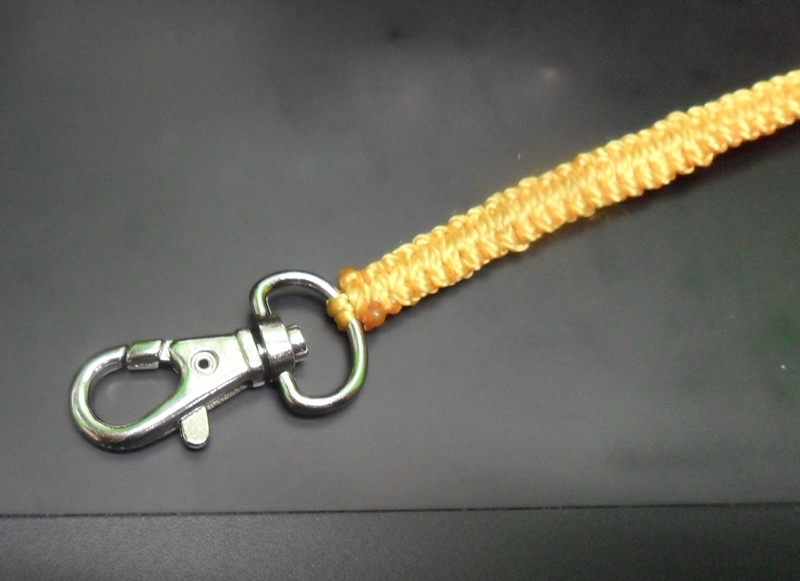
Sitting around waiting one afternoon, I pulled out some yellowy/orangey mason line (kinda crappy, but till I find a better quality orange cord, it will have to do), and some clasps and made him something.


 Simple Cobra Knot.

 His first Victorinox, a My First Victorinox.
This way he can clip it to his belt loop, to a D-ring inside his pack, he can make a wrist loop out of it.
As always, it’s an enjoyable, meditative act to sit and braid one of these. Just nice to do something that requires my fingers to move dexterously.
Being quite the charming negotiator, he casually mentioned that he sure liked my little lanyards and fobs and the like.
“Are you trying to tell me something.”
“Well, I was thinking that my Swiss Army Knife would look cool if it had one of those.”
“Sure buddy, I can bring you some cord and you can knock yourself out.”
“I don’t really know how to do that though. I was hoping that maybe you could make me one.” Big smile.
*sigh*
Sitting around waiting one afternoon, I pulled out some yellowy/orangey mason line (kinda crappy, but till I find a better quality orange cord, it will have to do), and some clasps and made him something.



This way he can clip it to his belt loop, to a D-ring inside his pack, he can make a wrist loop out of it.
As always, it’s an enjoyable, meditative act to sit and braid one of these. Just nice to do something that requires my fingers to move dexterously.
S.o.t.D. - Never Stop – Echo and the Bunnymen
Never Stop – Echo and the Bunnymen
Another of those bands I liked a lot back in the day and then just grew out of. No good reason why really. Added a bunch of their tracks to a playlist and have been listening to them for the last few hours. Rediscovering why I liked them.
Another of those bands I liked a lot back in the day and then just grew out of. No good reason why really. Added a bunch of their tracks to a playlist and have been listening to them for the last few hours. Rediscovering why I liked them.
Thursday, 17 November 2011
HMCS Haida
On Thanksgiving weekend, the Saturday was spectacular, and rather than be a shut in hunched over a computer working on type, I wandered down to the waterfront. Ended up down by the HMCS Haida. Any time I’ve been down at the Haida before, it’s a half hour before closing or it’s closed for the winter season. Well this time I was there before 10:00, and for a paltry $3.90 I got to explore a fascinating piece of Canadian history.
(Taking photos inside was a challenge, partially because I have a crappy camera, the light often isn’t great, but also because it is really cramped inside, and many of the rooms you can’t actually go into. The angles you’re forced to visually record the different rooms from are often not the best to get the whole picture. Still, I hope they give you an idea.)


 The prow of the ship.


 After coming aboard, I decided to start at the front and work my way back.


 These are the twin high angle 4" guns. The Haida was initially outfitted with three 4.7" guns, but these had a limited range of motion (-10° to 40°), and weren’t well suited for defense against enemy aircraft. Before long they were replaced with two 4" guns, which had an elevation of -10° to 85° . They were trained, elevated and fired electrically, but still loaded manually. There was however a manual backup, as with most of the systems on board, in case of a problem. 15 men manned the guns, with a further 12 supplying the ammo from below decks. The actual firing of the gun was done by the Loader, once the Gun Director on the bridge released the safety. Each barrel could fire 15 to 20 rounds per minute and it had a range of 14.5 km (9 miles or 7.8 nautical miles).

 This was the Shipwrights shop, just behind the 4" guns. Dig the rug on the floor.


 A scale model of the Haida as she would have looked in WW2.
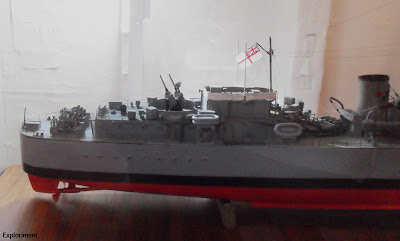

 A scale model of the Haida as she would have looked in the Korean War.
 The ladder leading down into the forward crew quarters.

 Various means of comms between sections and decks.


 Known as the Mess Deck, this is where the enlisted crewmen lived. At night, hammocks were suspended from the black bars on the ceiling, and in the day were taken down and stowed in the benches.
Besides the human inhabitants, there was also an English Terrier called Bunker B (whatever it was called before is unknown - after it was soaked in bunker fuel from a leaking tank B, that was the name it was given), and a rabbit called Handy Built (no idea how it got that name). There were also lots of cockroaches.
It didn’t take me long to figure out that I could never have served aboard one of these ships. I had to walk around on my haunches or bent at the waist in most places. I think the optimal height to serve on one would have been about 5'5".
 Lights! Action! Battlestations!


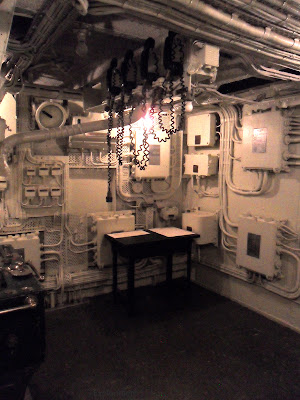
 This is where all the information about the target, its speed, range, direction it was moving in, as well as the speed and direction the Haida was moving in were calculated, and the resultant coordinates were then relayed to the gun crews.
I don’t know enough about the electronics of the time to know if this and all the boxes on the walls would have been what was on board in the early forties, or whether these are later additions from the time of the Korean War.

 The wash rooms for the enlisted crew, all 180 of them. Most guys were lucky to get three minutes of (probably not very warm) water every two or three days to wash and shave.
 Radio room. The Haida has four radio rooms, this being the main one. Messages were monitored, sent and received here.

 Wash area for the Petty Officers I believe.
 I believe this was the pursers office, where the day to day administrations and supplies of the ship were handled.
 Cramped quarters.

 This is the bakery for the enlisted crew, where the night bakers prepared bread and occasionally cakes and pies. When done, the breads were brought up to the main deck to be stored in the bread locker under canvas.


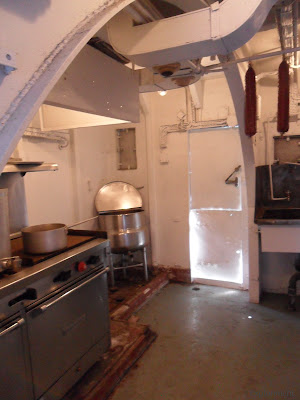 In this tiny galley, 3 or 4 men prepared meals for over 200 men. The food was served to the duty mess men, who would then carry it back to their respective messes or eating areas.
 Davits that held the motor cutters and whaler.
 Gangway.


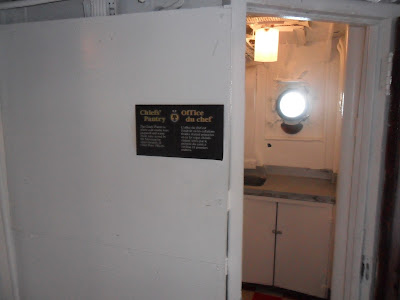


 The Chief Petty Officers Second Class living quarters, including a small galley and their mess area. This is where the men of the engineering department, responsible for the operation and maintenance of the engine room, boiler rooms and gearing room were housed. While they had a few more amenities than the enlisted crew members, their quarters were still very cramped, like all other areas of the ship.


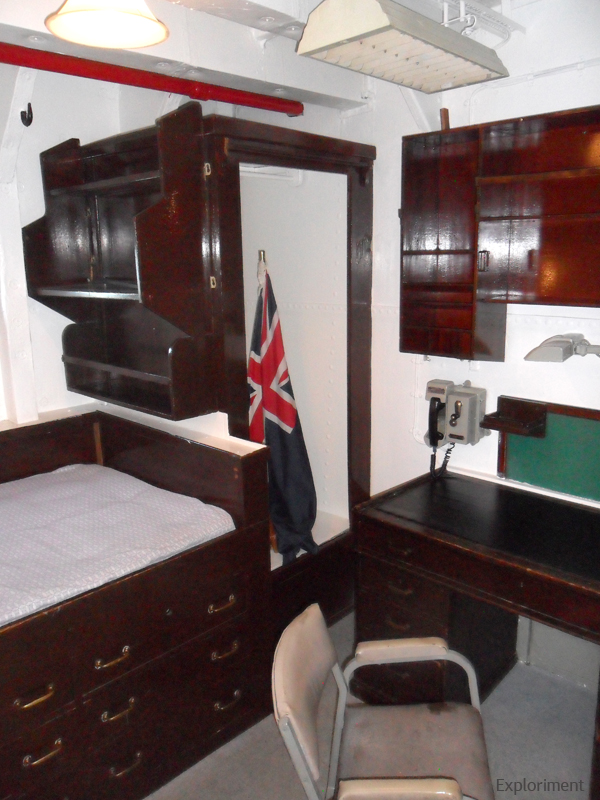
 This was the captains day cabin, where he spent most of his time when the ship was at sea. Steps away from the bridge and the operations room which were right above. He also had a day cabin, further aft, for when the ship was in port.


 The bridge, open to the elements. Can’t even begin to imagine how much of a challenge that must have been when they were doing the Murmansk run. Can’t really tell you what all the instruments were or what they did. Sorry. I’m a landlubber and the biggest boat I’m ever on is a canoe.
 Looking aft.


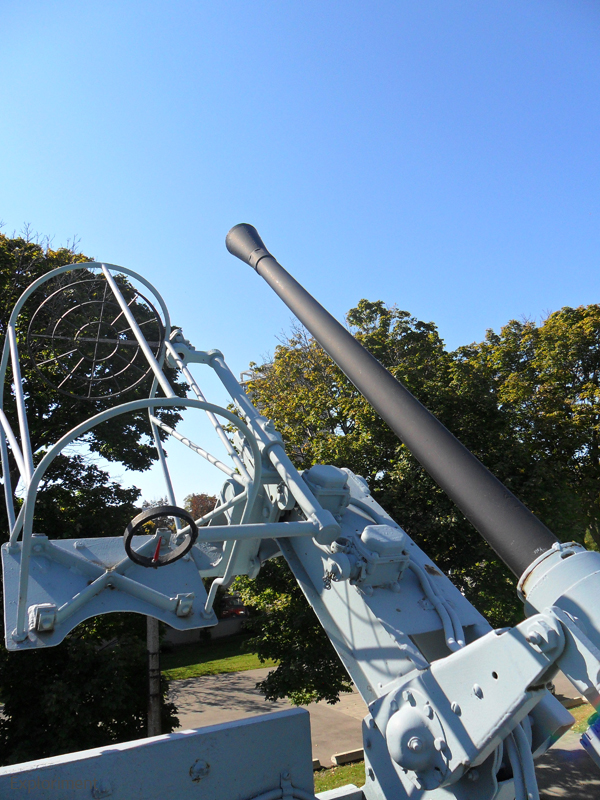
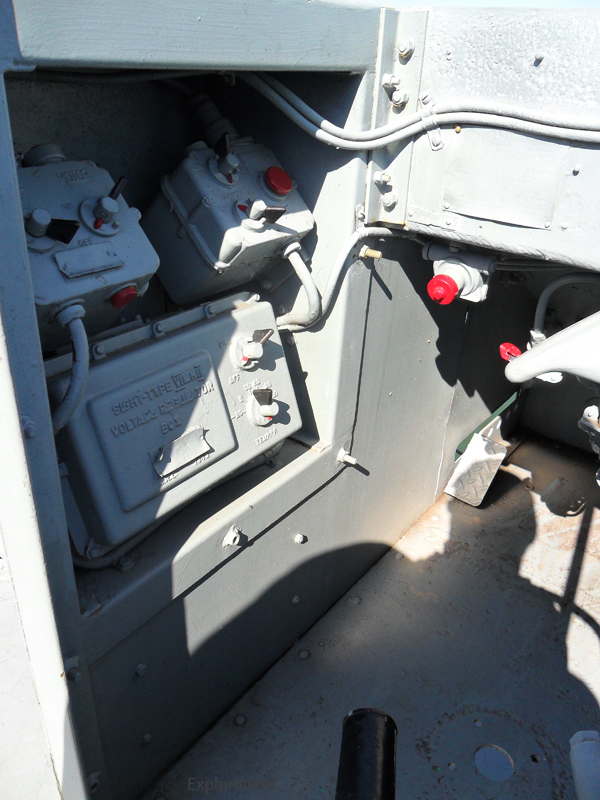
 40mm Boffins. Originally the Haida was equipped with 20mm Oerlikon cannons. These were later replaced with 4 single barrel 40mm Bofors cannons. Both weapon systems were meant to serve as anti-aircraft defense. The Boffin was a Canadian innovation where the Bofors were placed atop the Oerlikon mounts. They had an elevation of -10° to 70° which made them very useful for destroying floating mines during the Korean War, as their barrels could be positioned much lower than any of the Haida’s other guns. Served by a crew of 5, each barrel could fire 120 rounds per barrel per minute. Each gun had a range of approximately 5 km (3.1 miles or 2.7 nautical miles).
Interestingly they were made here in Hamilton at the old Studebaker plant – which if these guns were still operational, and the plant still standing, could hit.

 The laundry.
 The officers galley.

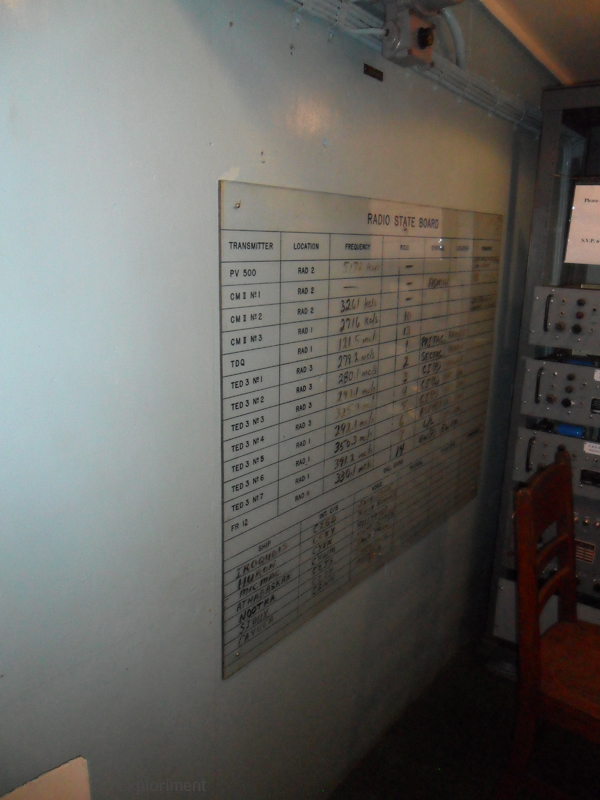
 Radio room 2. This room contains three high frequency transmitters and two receivers. The large unit (PV 500) was used for morse code or teletype. The other two units were primarily voice or morse code. Normally controlled from Radio 1, they could stand alone in an emergency.


 The Captain’s Day Cabin. The only private head and bath tub in the whole ship. This cabin could also be set up as an emergency operating theatre. Two successful operations were performed here while the ship was at sea.

 The sick bay – the ship’s infirmary and hospital. During wartime the ship had a medical doctor, and in peace time a highly trained sick bay attendant – nicknamed a ‘tiffy’. The bunks were used to quarantine patients or for injured awaiting transfer to shore. The seriously ill or injured were often transferred to a larger ship for treatment. Member’s of the ship’s crew who were sick or required treatment would line up for ‘sick parade’ each morning usually around 08:00.


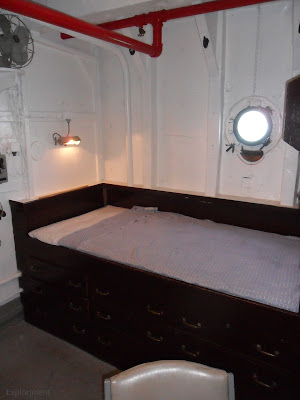


 Engineering office/engineering officers cabin.


 Coxswain’s (Regulating) Office. The senior NCO, the Coxswain worked closely with the Captain on the administration of the ship and crew. Mail was also sorted and sent from this office.
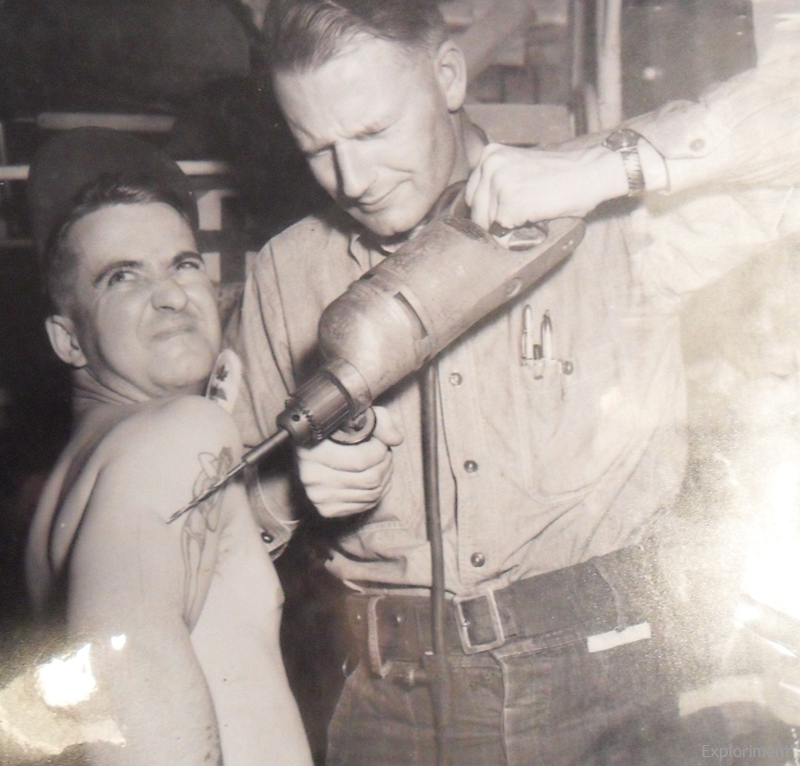
 How sailors aboard the Haida did tattoos.


 Torpedo launchers. The HMCS Haida carried four 21" Mark IX torpedoes. They were fired one after another in a spread and travelled up to 45 knots (84 kilometers) per hour, and as far as 5.5 knots (10 kilometers). They could be fired either to port or starboard. They were fired electrically from the bridge, or from the tubes themselves, either by electric motor or by hand. If they missed their target, they would sink to the ocean floor and explode. Each torpedo weighed 3000 pounds and was loaded while the ship was in harbour. The warhead contained 250 pounds of Torpex, which was equivalent to 800 pounds of TNT.

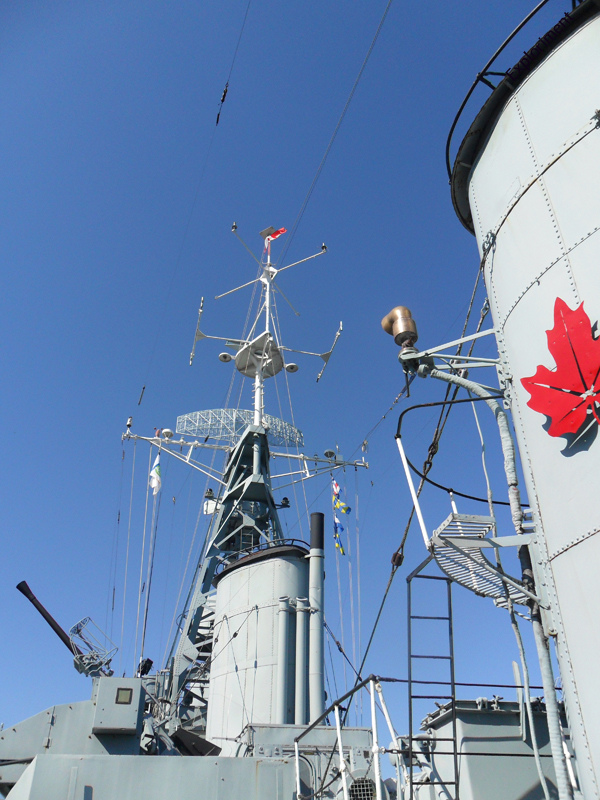
 Antenna.


 The emergency steering position. If the wheelhouse was damaged or failed, this was the back-up. When the ship was in action, this was where the executive officer (the second in command) was stationed.
 Another view of the davits.


 They could really liven the place up with some bright splashes of colour here and there.

 Oh here we go.


 During WW2 twin 4" guns were located here, but during the major refit, they were replaced with 3"50 guns, to serve as both anti-aircraft and surface weapons. During the Korean War, these guns were used to destroy North Korean and Chinese supply trains, destroying two locomotives on one patrol. Crewed by 12 men, with an elevation of -10° to 85°, each barrel could fire 40 rounds per minute, and had a range of 9.14 km (5.7 miles/5 nautical miles).
 Gunnery repair room.
 Magazine. Containing 200 rounds for the nearby 3"50 guns, interlocking canisters prevented rounds from moving around at sea. It also served as a shelter for the gun crews.


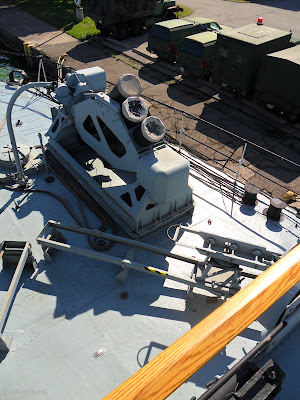
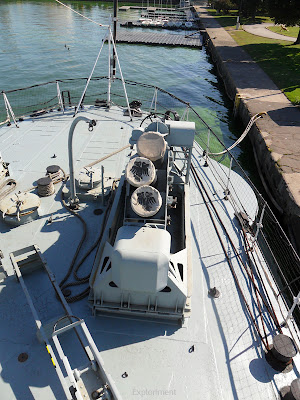 Squid anti-submarine mortars.
 The Squids themselves. Stored two decks below, they were hoisted up and placed on conveyors to be passed out to the mortars.

 Sea mines. No idea if these were Canadian, or if they were enemy sea mines.
 Secured to a bollard.


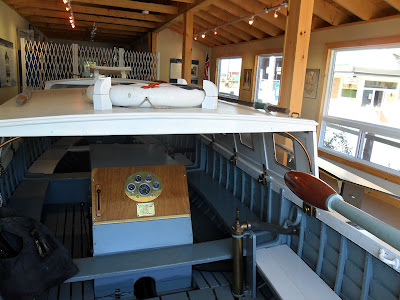
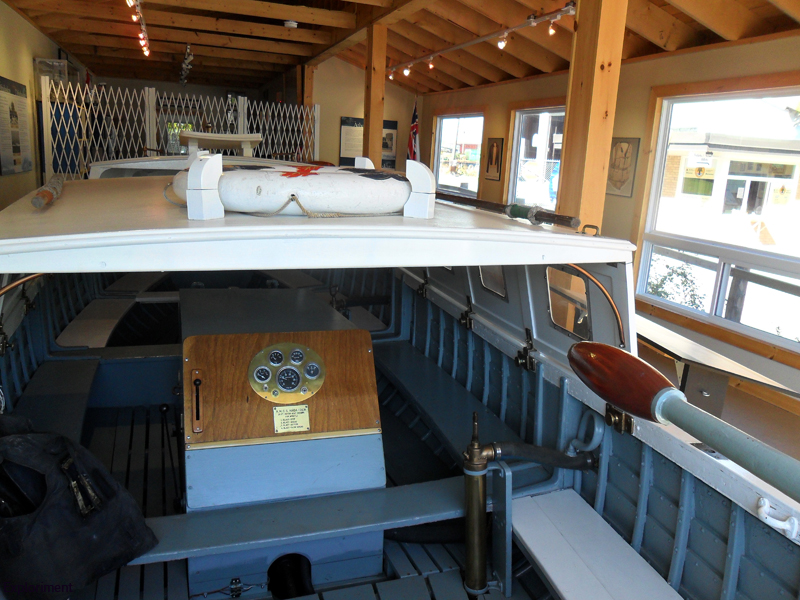
 The motor cutter. There were two of these on board, as well as a whaler, which was powered by oars or sails. Mainly used to transfer personnel and supplies between ship or shore.
 On April 29th 1944, the HMCS Athabaskan and the HMCS Haida were in the English Channel to support a mine laying operation. Two German Elbe class destroyers, the T24 and T27, fired torpedoes and fled. The Athabaskan was hit and ten minutes later there was a second explosion. Within seconds she was submerged. Haida laid a smoke screen to protect her sister ship and turned to pursue the German destroyers. When she returned, the Athabsakan was gone and her crew spread over a half-mile of the English Channel.
Haida’s crew used ropes and nets to rescue 42 men, before Captain Harry DeWolf had to make the heart-breaking decision to depart. German planes would begin patrols at daybreak, and DeWolf had to save his own ship and crew from possible attack. Before departing he ordered his men to lower all the motor cutters, and Carley life rafts. I can’t even begin to fathom how that must have affected them.
Three men, Able Seaman Jack Hannam, Leading Seaman Jack McClure and Stoker William Cummings, stayed behind to try to rescue as many as they could, and managed to save 8. The cutter and its 11 passengers then made a 160 km journey back to England. The journey took 16 hours as they struggled with a spluttering engine. Thirsty, hungry, exhausted and despairing, they were finally rescued off the coast of Penzance.
(The dog mentioned earlier, Bunker B, was another loss of the battle. Usually locked in a room, for whatever reason he was was not. When the Athabaskan exploded, he was so frightened, he jumped off the ship and was never found.)
 German forces picked up 85 survivors.
In all the Athabaskan lost 128 men, more than half her complement. Of those, 91 are buried in cemeteries along the coast of Brittany in France. The others rest at the site of the Athabaskan’s sinking, which is now a protected war grave in honour of those who perished with her.
I think they need to dust the building that houses the motor cutter a little more frequently, cause my allergies acted up in there.


 Named after indigenous peoples of the British Empire, 27 Tribal class destroyers were built for Great Britain, Australia and Canada. 27 were built, 13 were sunk, 13 were scrapped – only the Haida remains.
 She is currently closed for the winter season, but definitely worth a trip if you’re in the area between May and November.
(Taking photos inside was a challenge, partially because I have a crappy camera, the light often isn’t great, but also because it is really cramped inside, and many of the rooms you can’t actually go into. The angles you’re forced to visually record the different rooms from are often not the best to get the whole picture. Still, I hope they give you an idea.)


Besides the human inhabitants, there was also an English Terrier called Bunker B (whatever it was called before is unknown - after it was soaked in bunker fuel from a leaking tank B, that was the name it was given), and a rabbit called Handy Built (no idea how it got that name). There were also lots of cockroaches.
It didn’t take me long to figure out that I could never have served aboard one of these ships. I had to walk around on my haunches or bent at the waist in most places. I think the optimal height to serve on one would have been about 5'5".


I don’t know enough about the electronics of the time to know if this and all the boxes on the walls would have been what was on board in the early forties, or whether these are later additions from the time of the Korean War.





Interestingly they were made here in Hamilton at the old Studebaker plant – which if these guns were still operational, and the plant still standing, could hit.












Haida’s crew used ropes and nets to rescue 42 men, before Captain Harry DeWolf had to make the heart-breaking decision to depart. German planes would begin patrols at daybreak, and DeWolf had to save his own ship and crew from possible attack. Before departing he ordered his men to lower all the motor cutters, and Carley life rafts. I can’t even begin to fathom how that must have affected them.
Three men, Able Seaman Jack Hannam, Leading Seaman Jack McClure and Stoker William Cummings, stayed behind to try to rescue as many as they could, and managed to save 8. The cutter and its 11 passengers then made a 160 km journey back to England. The journey took 16 hours as they struggled with a spluttering engine. Thirsty, hungry, exhausted and despairing, they were finally rescued off the coast of Penzance.
(The dog mentioned earlier, Bunker B, was another loss of the battle. Usually locked in a room, for whatever reason he was was not. When the Athabaskan exploded, he was so frightened, he jumped off the ship and was never found.)

In all the Athabaskan lost 128 men, more than half her complement. Of those, 91 are buried in cemeteries along the coast of Brittany in France. The others rest at the site of the Athabaskan’s sinking, which is now a protected war grave in honour of those who perished with her.
I think they need to dust the building that houses the motor cutter a little more frequently, cause my allergies acted up in there.


Subscribe to:
Comments (Atom)


 Posts
Posts


