Thursday, 17 November 2011

HMCS Haida

On Thanksgiving weekend, the Saturday was spectacular, and rather than be a shut in hunched over a computer working on type, I wandered down to the waterfront. Ended up down by the HMCS Haida. Any time I’ve been down at the Haida before, it’s a half hour before closing or it’s closed for the winter season. Well this time I was there before 10:00, and for a paltry $3.90 I got to explore a fascinating piece of Canadian history. 

(Taking photos inside was a challenge, partially because I have a crappy camera, the light often isn’t great, but also because it is really cramped inside, and many of the rooms you can’t actually go into. The angles you’re forced to visually record the different rooms from are often not the best to get the whole picture. Still, I hope they give you an idea.) 
The prow of the ship.
After coming aboard, I decided to start at the front and work my way back.
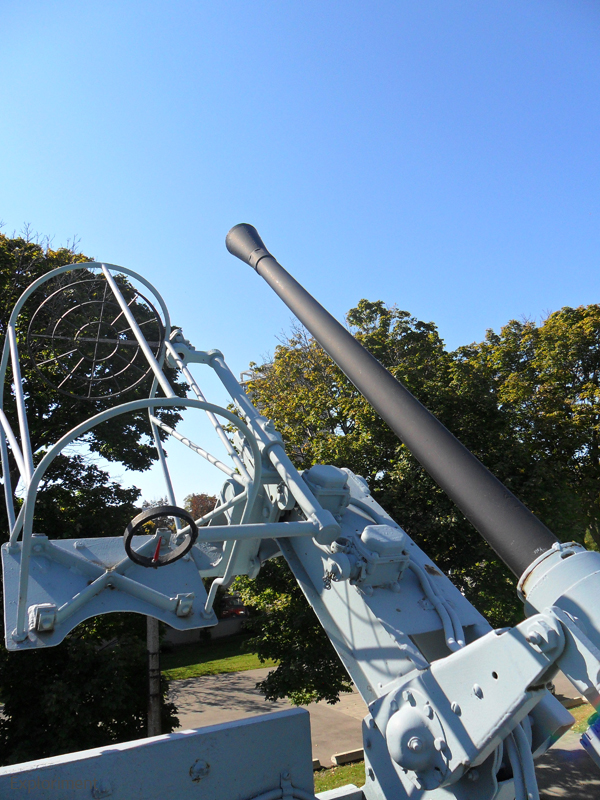
These are the twin high angle 4" guns. The Haida was initially outfitted with three 4.7" guns, but these had a limited range of motion (-10° to 40°), and weren’t well suited for defense against enemy aircraft. Before long they were replaced with two 4" guns, which had an elevation of -10° to 85° . They were trained, elevated and fired electrically, but still loaded manually. There was however a manual backup, as with most of the systems on board, in case of a problem. 15 men manned the guns, with a further 12 supplying the ammo from below decks. The actual firing of the gun was done by the Loader, once the Gun Director on the bridge released the safety. Each barrel could fire 15 to 20 rounds per minute and it had a range of 14.5 km (9 miles or 7.8 nautical miles).
This was the Shipwrights shop, just behind the 4" guns. Dig the rug on the floor.
A scale model of the Haida as she would have looked in WW2.
A scale model of the Haida as she would have looked in the Korean War.
The ladder leading down into the forward crew quarters.
Various means of comms between sections and decks.
Known as the Mess Deck, this is where the enlisted crewmen lived. At night, hammocks were suspended from the black bars on the ceiling, and in the day were taken down and stowed in the benches.

Besides the human inhabitants, there was also an English Terrier called Bunker B (whatever it was called before is unknown - after it was soaked in bunker fuel from a leaking tank B, that was the name it was given), and a rabbit called Handy Built (no idea how it got that name). There were also lots of cockroaches.

It didn’t take me long to figure out that I could never have served aboard one of these ships. I had to walk around on my haunches or bent at the waist in most places. I think the optimal height to serve on one would have been about 5'5".
Lights! Action! Battlestations!
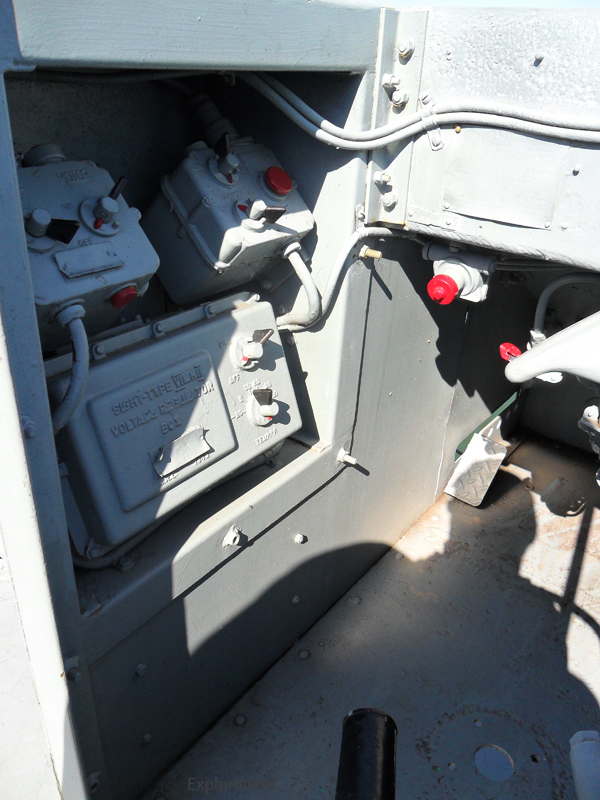
This is where all the information about the target, its speed, range, direction it was moving in, as well as the speed and direction the Haida was moving in were calculated, and the resultant coordinates were then relayed to the gun crews.

I don’t know enough about the electronics of the time to know if this and all the boxes on the walls would have been what was on board in the early forties, or whether these are later additions from the time of the Korean War.

The wash rooms for the enlisted crew, all 180 of them. Most guys were lucky to get three minutes of (probably not very warm) water every two or three days to wash and shave.
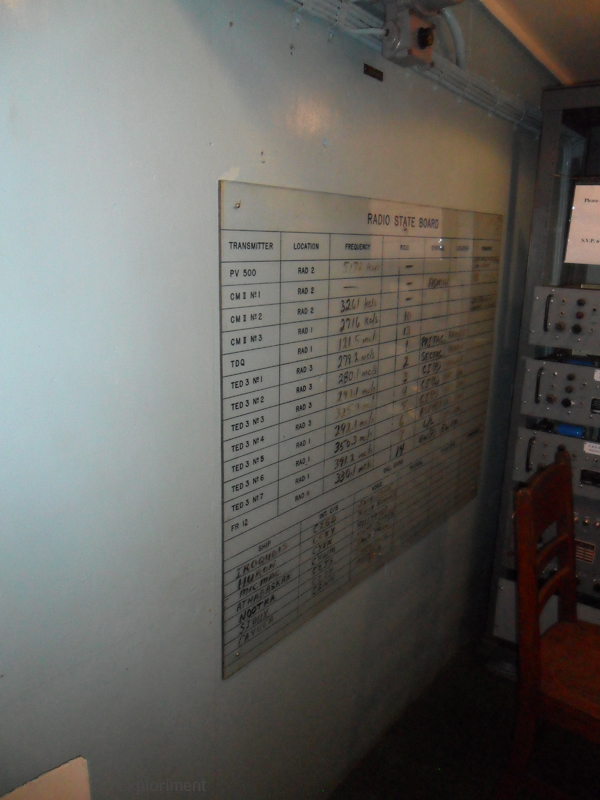
Radio room. The Haida has four radio rooms, this being the main one. Messages were monitored, sent and received here.
Wash area for the Petty Officers I believe.
I believe this was the pursers office, where the day to day administrations and supplies of the ship were handled.
Cramped quarters.
This is the bakery for the enlisted crew, where the night bakers prepared bread and occasionally cakes and pies. When done, the breads were brought up to the main deck to be stored in the bread locker under canvas.
In this tiny galley, 3 or 4 men prepared meals for over 200 men. The food was served to the duty mess men, who would then carry it back to their respective messes or eating areas.
Davits that held the motor cutters and whaler.

Gangway.
The Chief Petty Officers Second Class living quarters, including a small galley and their mess area. This is where the men of the engineering department, responsible for the operation and maintenance of the engine room, boiler rooms and gearing room were housed. While they had a few more amenities than the enlisted crew members, their quarters were still very cramped, like all other areas of the ship.
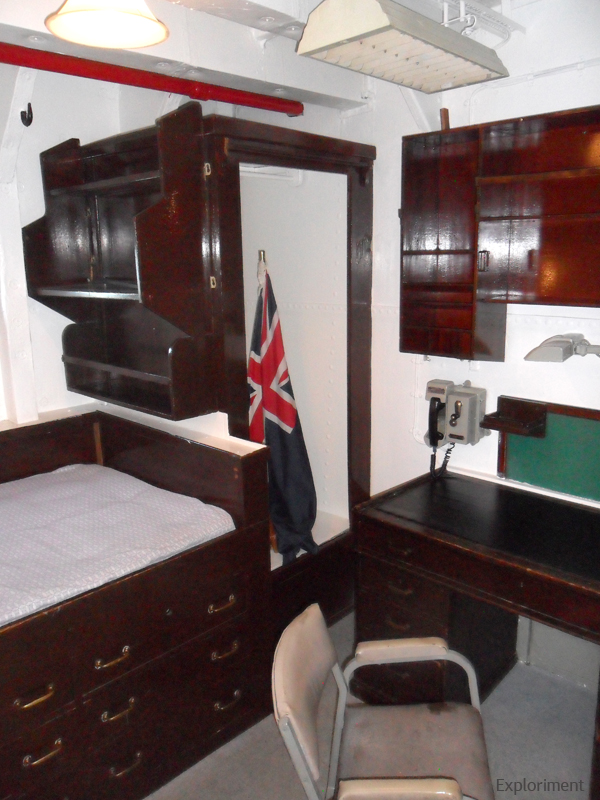
This was the captains day cabin, where he spent most of his time when the ship was at sea. Steps away from the bridge and the operations room which were right above. He also had a day cabin, further aft, for when the ship was in port.
The bridge, open to the elements. Can’t even begin to imagine how much of a challenge that must have been when they were doing the Murmansk run. Can’t really tell you what all the instruments were or what they did. Sorry. I’m a landlubber and the biggest boat I’m ever on is a canoe.

Looking aft.
40mm Boffins. Originally the Haida was equipped with 20mm Oerlikon cannons. These were later replaced with 4 single barrel 40mm Bofors cannons. Both weapon systems were meant to serve as anti-aircraft defense. The Boffin was a Canadian innovation where the Bofors were placed atop the Oerlikon mounts. They had an elevation of -10° to 70° which made them very useful for destroying floating mines during the Korean War, as their barrels could be positioned much lower than any of the Haida’s other guns. Served by a crew of 5, each barrel could fire 120 rounds per barrel per minute. Each gun had a range of approximately 5 km (3.1 miles or 2.7 nautical miles).

Interestingly they were made here in Hamilton at the old Studebaker plant – which if these guns were still operational, and the plant still standing, could hit.
The laundry.
The officers galley. 
Radio room 2. This room contains three high frequency transmitters and two receivers. The large unit (PV 500) was used for morse code or teletype. The other two units were primarily voice or morse code. Normally controlled from Radio 1, they could stand alone in an emergency.
The Captain’s Day Cabin. The only private head and bath tub in the whole ship. This cabin could also be set up as an emergency operating theatre. Two successful operations were performed here while the ship was at sea.
The sick bay – the ship’s infirmary and hospital. During wartime the ship had a medical doctor, and in peace time a highly trained sick bay attendant – nicknamed a ‘tiffy’. The bunks were used to quarantine patients or for injured awaiting transfer to shore. The seriously ill or injured were often transferred to a larger ship for treatment. Member’s of the ship’s crew who were sick or required treatment would line up for ‘sick parade’ each morning usually around 08:00.
Engineering office/engineering officers cabin.
Coxswain’s (Regulating) Office. The senior NCO, the Coxswain worked closely with the Captain on the administration of the ship and crew. Mail was also sorted and sent from this office.
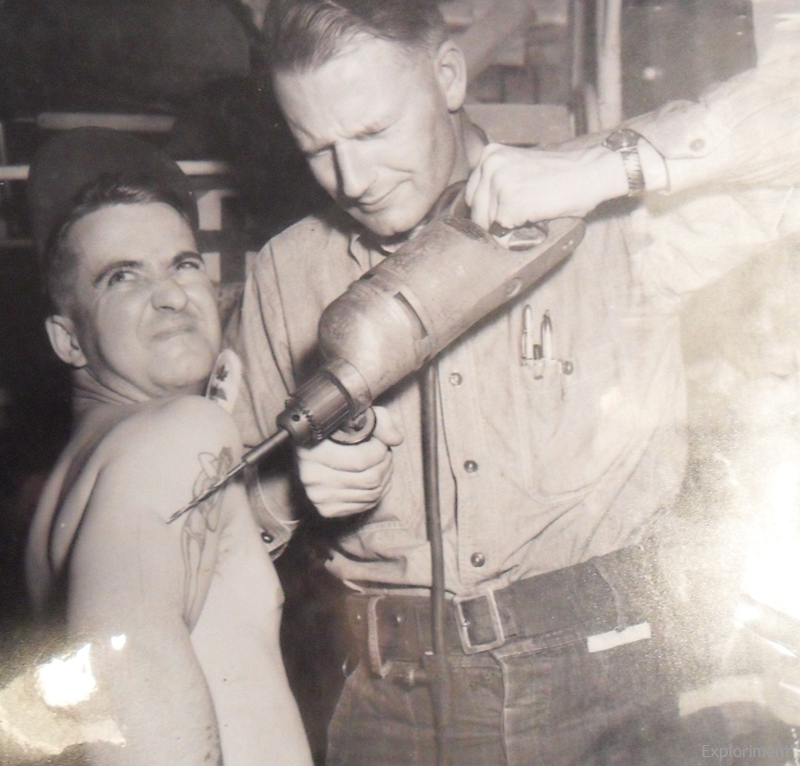
How sailors aboard the Haida did tattoos.
Torpedo launchers. The HMCS Haida carried four 21" Mark IX torpedoes. They were fired one after another in a spread and travelled up to 45 knots (84 kilometers) per hour, and as far as 5.5 knots (10 kilometers). They could be fired either to port or starboard. They were fired electrically from the bridge, or from the tubes themselves, either by electric motor or by hand. If they missed their target, they would sink to the ocean floor and explode. Each torpedo weighed 3000 pounds and was loaded while the ship was in harbour. The warhead contained 250 pounds of Torpex, which was equivalent to 800 pounds of TNT.

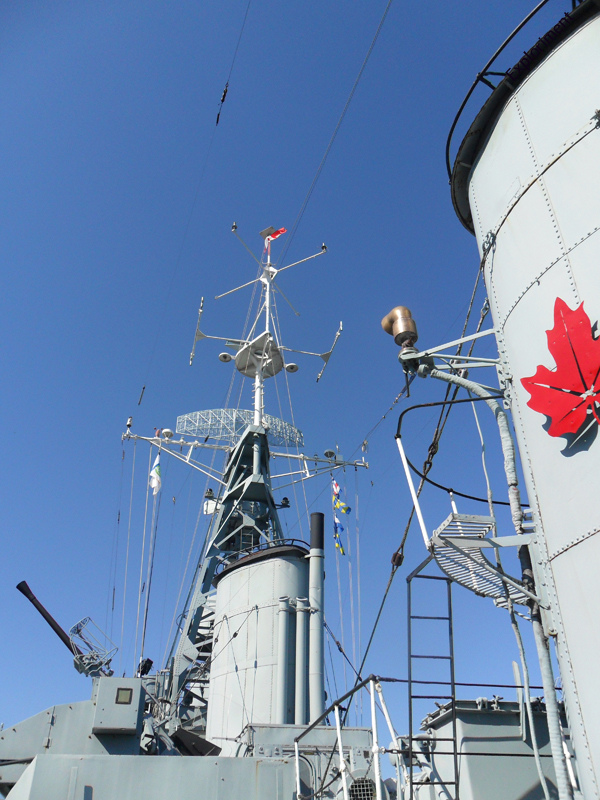
Antenna.
The emergency steering position. If the wheelhouse was damaged or failed, this was the back-up. When the ship was in action, this was where the executive officer (the second in command) was stationed.
Another view of the davits.
They could really liven the place up with some bright splashes of colour here and there.
Oh here we go.
During WW2 twin 4" guns were located here, but during the major refit, they were replaced with 3"50 guns, to serve as both anti-aircraft and surface weapons. During the Korean War, these guns were used to destroy North Korean and Chinese supply trains, destroying two locomotives on one patrol. Crewed by 12 men, with an elevation of -10° to 85°, each barrel could fire 40 rounds per minute, and had a range of 9.14 km (5.7 miles/5 nautical miles).
Gunnery repair room.
Magazine. Containing 200 rounds for the nearby 3"50 guns, interlocking canisters prevented rounds from moving around at sea. It also served as a shelter for the gun crews.
Squid anti-submarine mortars.
The Squids themselves. Stored two decks below, they were hoisted up and placed on conveyors to be passed out to the mortars.
Sea mines. No idea if these were Canadian, or if they were enemy sea mines.
Secured to a bollard.
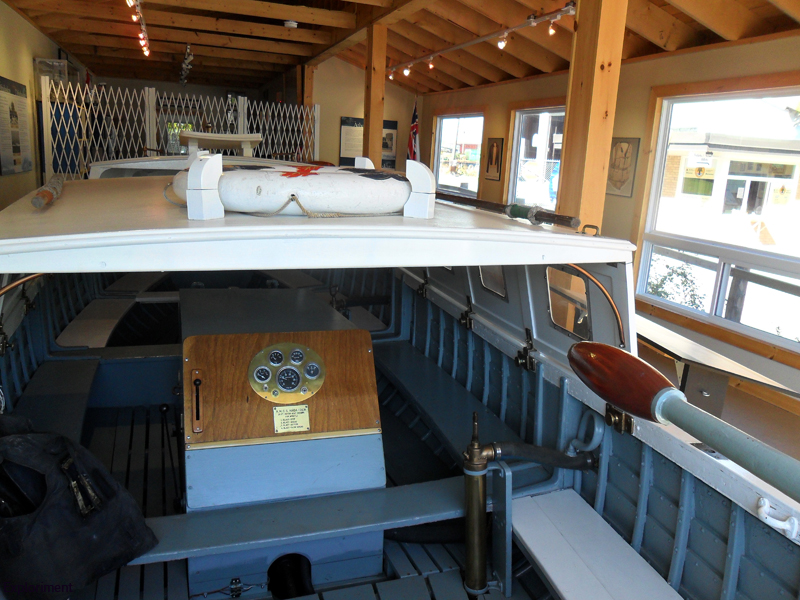
The motor cutter. There were two of these on board, as well as a whaler, which was powered by oars or sails. Mainly used to transfer personnel and supplies between ship or shore.
On April 29th 1944, the HMCS Athabaskan and the HMCS Haida were in the English Channel to support a mine laying operation. Two German Elbe class destroyers, the T24 and T27, fired torpedoes and fled. The Athabaskan was hit and ten minutes later there was a second explosion. Within seconds she was submerged. Haida laid a smoke screen to protect her sister ship and turned to pursue the German destroyers. When she returned, the Athabsakan was gone and her crew spread over a half-mile of the English Channel.

Haida’s crew used ropes and nets to rescue 42 men, before Captain Harry DeWolf had to make the heart-breaking decision to depart. German planes would begin patrols at daybreak, and DeWolf had to save his own ship and crew from possible attack. Before departing he ordered his men to lower all the motor cutters, and Carley life rafts. I can’t even begin to fathom how that must have affected them.

Three men, Able Seaman Jack Hannam, Leading Seaman Jack McClure and Stoker William Cummings, stayed behind to try to rescue as many as they could, and managed to save 8. The cutter and its 11 passengers then made a 160 km journey back to England. The journey took 16 hours as they struggled with a spluttering engine. Thirsty, hungry, exhausted and despairing, they were finally rescued off the coast of Penzance.

(The dog mentioned earlier, Bunker B, was another loss of the battle. Usually locked in a room, for whatever reason he was was not. When the Athabaskan exploded, he was so frightened, he jumped off the ship and was never found.)
German forces picked up 85 survivors.

In all the Athabaskan lost 128 men, more than half her complement. Of those, 91 are buried in cemeteries along the coast of Brittany in France. The others rest at the site of the Athabaskan’s sinking, which is now a protected war grave in honour of those who perished with her.

I think they need to dust the building that houses the motor cutter a little more frequently, cause my allergies acted up in there. 
Named after indigenous peoples of the British Empire, 27 Tribal class destroyers were built for Great Britain, Australia and Canada. 27 were built, 13 were sunk, 13 were scrapped – only the Haida remains.
She is currently closed for the winter season, but definitely worth a trip if you’re in the area between May and November.

S.o.t.D. - Rain – Tones on Tail

Rain – Tones on Tail 

After Bauhaus and before Love & Rockets. I liked ToT better than both.

Bibliophilia: The Great Northern Brotherhood of Canadian Cartoonists – Seth

The G.N.B Double C: The Great Northern Brotherhood of Canadian Cartoonists – Seth

An odd little book, like all his others. It ostensibly tells a history of Canadian cartooning, through the ploy of a tour through one of the declining lodges of the Great Northern Brotherhood of Canadian Cartoonists. I thought the only fictional aspect was this imaginary lodge in a make-believe town. He discusses with quite a bit of accuracy the old Doug Wrights Family, which I recall very well from growing up. (I wonder whether there has ever been a more meticulous visual chronicling of life in 60s/70s suburban Canada.) All the other stories he discusses I therefore thought were also real, and some of them sounded intriguing enough that I wanted to find them. It turns out that they were all inventions of the author. He does a pretty good job of convincing you that there was once a golden era where Canadian cartoonists were exalted citizens, who congregated in posh fraternal lodges, but also that this should have been. Like I said, bit of a head scratcher.

Wednesday, 16 November 2011

Monday, 14 November 2011

S.o.t.D. - Kloke (Hidden Agenda Remix) – King Kooba

Kloke (Hidden Agenda Remix) – King Kooba 

Chugging tempo and a rumbling bassline. That’s what its all about.

Type Design - Cosmodrome Serif Micromum

Another weight a good portion of the way done. Lots of kerning, etc., still to be done. And a big part of this is trying it out, printing it out at various sizes, those sorts of things. That will reveal flaws, inconsistencies, etc. For the most part all I see are individual characters in their cell. Sure, I can set a little “The Quick Brown Fox....” in FontLab Studio but I don’t have a huge monitor so I’m limited as to how large I can view it. Nor is it that easy to set different text. Turning it into an actual font and being able to easily see multiple characters combined in a view different programs on a few different monitors is very helpful. This better tells me if some characters need to be narrower, or wider, or any other problems it may exhibit.

Read more about it, and the other variants I’ve managed to complete so far here.

Sunday, 13 November 2011

Saturday, 12 November 2011

S.o.t.D. - Journeyman – Amon Tobin

Journeyman – Amon Tobin 

Indubitably (I don’t get to use that word often enough) one of the most interesting and original producers in music today.

Friday, 11 November 2011

Japanese Maple

It’s November but the leaves on this Japanese Maple are still on and still the most intensely vibrant, gorgeous shade of red.

Signage: super low tech

I love the wonderful naiveté of some signs. Saw one on a post today, that I really hope was done by a kid looking to earn some pocket money. Even then....it can’t be that hard to get your hands on a computer that at least has a word processing program...to make your sign look....just a little more professional. Or maybe even a Sharpie to make look like more than a blank sheet of paper from a few meters away?

11:11 11/11/11

© National Archives of Canada  C-38723

I had a conversation about war with my nephew recently. I had gone to the library with him and we had looked at books on all sorts of things, including ones with pictures of tanks and planes. We went back to his place and got into making Lego versions of some of these things. He asked me all sorts of questions about them, and about war in general, WW2 in particular. His grandmother is from Holland, and I am as well. I tried to explain to him why I tend to get a bit verklempt on Remembrance Day. That guys just like his dad, just like me, just like all his other uncles and the fathers of his school chums all felt that what was happening in Europe was egregious enough that they volunteered to go and do something about it. That they left behind their families, their wives, their girlfriends, their children, their homes, their businesses. That some of them didn’t come back for 6 years. That some of them spent years languishing in a POW camp, bored out of their skulls and hungry if they were guests of Hitler, tortured and starved if they were guests of Tojo. That some were horribly wounded and maimed, sometimes with grotesquely visible wounds, sometimes with invisible, though no less grotesque injuries. Sometimes they never came back - drowned in the Atlantic, burned alive inside a tank in France, blown to smithereens over Germany. Young men who wanted nothing more than to wake up next to their wives, watch their children grow up, practice their trade. Instead they did what was asked of them, doing the right thing.

I seem to recall this photo dates from 1939. I get choked up every time I look at that photo. I wonder how long this father was separated from his wife and son. I wonder how long this son and wife were separated from their father and husband. I wonder how much she and every other mother/sister/wife/daughter worried. I wonder if they ever saw each other again.

War is a horrible thing. But I will be eternally grateful to those who stand guard against tyranny. I will be eternally grateful to those people who gave up years of their lives, their freedom, their health, their mental well being, even their very lives, to liberate the country I was born in. I don’t think 2 minutes to reflect on the gravitas of that photo, to really think what was sacrificed in the accomplishment of a noble goal is too much to ask.

Follow up story to this.

S.o.t.D. - Symphony No. 3: II. Lento E Largo - Tranquillissimo – Henryk Górecki

Symphony No. 3: II. Lento E Largo - Tranquillissimo – Henryk Górecki 

Seemed like a very fitting piece of music for today.

Thursday, 10 November 2011

S.o.t.D. - Breathe (Live) – Ministry

Breathe (Live) – Ministry 

I only really put this up for the first three minutes, featuring the incredible double drum intro by Bill Rieflin and Martin Atkins. Kickass! Saw Ministry on this tour. Great show.

Wednesday, 9 November 2011

Bibliophilia: Captain Gravity and the Power of the Vril – Joshua Dysart, Sal Velluto, Mike Garcia

With a flying man, super powers, Nazis, occultists, damsels in distress, archeologists looking for a lost civilization, Hollywood movie sets, Russian spies, British secret agents, locations all over the globe - this wonderful graphic novel is a terrific homage to the pulp serials of decades past. Great story, great art. If I was to offer up a lazy comparison, I would say Indiana Jones meets the Rocketeer.

S.o.t.D. - One Of These Nights – The Eagles

One Of These Nights – The Eagles 

Sorry. I’m kind of going back on my general aversion to classic rock. It’s not like it needs any more exposure. But this is just an awesome song.

Great remix of it:
One Of These Nights (Revenge Rework) – The Eagles

CD3WD

Given my interest in resilient communities, and my worry about how things are going in the world, I wanted to share this incredible resource of information.

I suspect that every conceivable subject pertaining to agriculture in some way or other is to be found here. It appears to be directed mainly towards third world nations, and less technologically developed agriculture. Which...might just be us soon.

The “index page” alone is 100 pages printed. Just to give you an idea of how much is there. 


http://www.cd3wd.com/CD3WD_40/CD3WD/index.htm 

Located in Botswana, CD3WD is a free but high quality collection of practical How-To Technical Development Information - helping the 3rd world to help itself. There are 4000 titles, totalling 13 gigabytes of free high quality technical development information on Agriculture, Forestry, Fisheries, Food Processing, Small Industries, Engineering, Construction, Water and Sanitation, Accountancy, Economics, Education, Health and in fact (almost) everything under the sun. Hosted free online and also - very importantly - made available for free download and onward dissemination via flash ram, CD, DVD, external hard drive etc.

Reflections on walking

I have a suspicion that most people envision sitting cross legged on the floor when you mention meditation. but there is a long history in various eastern religious and spiritual practices of walking meditation. I find walking a very meditative act. Besides the getting me around, and the exercise aspect of it, I just find it a great way to get the creative juices flowing and also just to clear my head of negative energy. And while I enjoy the company of others, I’m perfectly content to walk by myself.

I went for years not having a camera (alas, so many missed opportunities). Back then I seemed to enjoy the aspect of covering as much ground in as short a time as I could. Now I find myself meandering a lot more, doing a lot of goofing off with a camera, and the distances covered aren’t as much as they once were. Or maybe I’m getting old and slowing down. Either way, it’s all good. Whether I enjoy the activity for the sake of the activity, or enjoy a fun hobby along the way, I’m engaged in something I enjoy. And in a way, the photography compels me to get out more, and it also compels me to go places I may not have been before.

I suppose another reason why I prefer to do any sort of spiritual fine tuning or whatever you want to call it while wandering about is that I send enough time sitting behind a computer or a light table or a work bench or on a train. I really value any and all opportunity to be on my feet, propelling myself forwards, either aimlessly or towards some destination.

Another aspect I enjoy so much is that you are bound to see and hear and smell and just plain sense many more phenomena than you ever will in a wheeled vehicle. The scope and depth of the sounds of nature that I hear when walking around is amazing. Coming up on scenes that anyone in a car would whiz right past makes me happy. 

It seems hard for some people to fathom, but humanity spread from the center of Africa all the way out to Australia and Tierra Del Fuego. We’re designed to walk. I recall reading a quote by Herzog once where he said that we’ve been estranged from something essential, which is travelling on foot, and leading a nomadic life.

I often receive a stunned reaction when I tell people I just walked 30 kilometers. Why? Are we all really so estranged from this vital and most human activity that they can’t imagine walking a distance like that?

 I hope that if I live to an old age that walking remains a cherished and essential part of it right up until the very end.

Bibliophilia: The Wayfinders: Why Ancient Wisdom Matters in the Modern World – Wade Davis

The Wayfinders: Why Ancient Wisdom Matters in the Modern World – Wade Davis

I’ve read several of his other books and this was just as magnificent. Whether writing or speaking, the mans words are a pleasure to read or hear. The section on the peoples of the Pacific in particular is amazing. Early European explorers of course arrogantly assumed that they were “primitive.” Their navigational abilities, that they could spread out across a huge part of the globe via small boats, centuries, possibly even millennia before Europeans could have achieved such a feat, proves that to be a predictable mix of hubris and arrogance. I’m thrilled to learn that there are people striving to retain and teach others the knowledge to allow them to traverse a huge ocean by reading currents and the stars and signs of nature.

Sadly there are many skills, skills that took generations to acquire and hone, and that have been passed down through countless generations, that are either under threat of extinction, or have already been lost, often in a generation or two. Western civilization, and I use them term loosely, has much blame to bear for this deplorable state of affairs as it seeks to spread its mono-culture across the globe. These are skills that may well be crucial for the survival of humanity as a species in the decades and centuries to come.

Like all his other books, this one is very laudable, very readable, and very recommended. There is much about the human race that inspires despair and disgust. This book helps to remind us that we are also capable of inspiring awe and admiration.

Tuesday, 8 November 2011

Murmuration

Canoe trips are always magical, but this one would be extra especially amazing.

Bibliodyssey

Bibliodyssey is a fantastic resource for anyone who is a fan of books, specifically finely printed books. Some of them go back a half millennia. Great representation of art and science books. You may not be able to afford to purchase them, but still nice to be able to glimpse them at least.

http://bibliodyssey.blogspot.com/

Wood That Works

Fascinating, and totally trippy, wooden kinetic sculptures by David C. Roy. I think I would like them more if the mechanism was hidden behind the wall, but cool regardless.

Shimmer

S.o.t.D. - A Truly Happy Ending – Junior Boys

A Truly Happy Ending – Junior Boys 

Local boys. Well, only one of them still lives here. I’ve had beers and coffees in his bar actually. If you’re a fan of early 80’s electronic pop, these fellas will be right up your alley.

Monday, 7 November 2011

Buckthorn Busting

Went to help RBG staff remove buckthorn from its property near McMaster University on Sunday. Crossing the 403 on the way there.

Buckthorn is an introduced plant in North America, that is classified as an invasive species. It out-competes native plants for nutrients, light, and moisture, partly because the leaves and roots emit a substance that is poisonous to the roots of other plants. Similar to black walnuts and sunflowers which also have this allelopathic feature - severely reducing the plant population growing beneath them. It contributes to erosion by shading out other plants that grow on the forest floor. It lacks “natural controls” like insects or disease that would curb its growth, and serves as host to other pests, such as crown rust fungus and soybean aphid.

It’s easily identifiable in fall because while most other trees have already shed their leaves, its egg shaped green leaves remain on, the leaves appear opposite one another, like outstretched arms and also its pea sized black berries.

I brought along some tools. They provided some tree pulling tools called Extractigators, some devices to girdle a tree to big to pull, some shovels (a bunch of native vegetation was planted), a couple of crappy hatchets. I brought along my kukri. Have I mentioned that I love my kukri? I do. As much as I love it though, I don’t get nearly as many chances as I would like to use it. Walking down the street with it strapped to my belt during my day to day affairs would likely mean frequent conversations with police officers. I can move very deftly through very rough terrain, so it isn’t like I would use it then to hack and slash at vegetation. I try to be very low impact on my camping trips, and if I do use my BushBuddy, a few handfuls of gathered dry twigs suffice.

So when knowledgeable biologists grant me permission to exterminate specified trees with gleeful abandon - hot diggety! Any buckthorns under an inch or two in diameter could be pulled from the ground, roots and all. Anything much bigger than that, was girdled, in order to kill it. I used my kukri to hack a circle all around it.
Chips flew. Razor sharp and hefty, and with strong, controlled swings, if I had wanted to take the whole tree down and not just remove an area of bark, it would have been quite easy.

Several times I saw people futilely flailing away with one of the axe shaped lumps of steel with a handle on it, trying to remove stubborn roots. I went over and with one swing severed the offending root. 
After doing that a few times, I realized I could use it as a spokeshave, and easily and quickly sliced off foot long strips of bark and cambium. Did dozens of trees that way. 
I also brought along my Leatherman Vista which I used in this instance, but the kukri was more fun.
Had lunch around a campfire. We roasted weenies, but putting my hands near the heat wasn’t fun so I grabbed some split logs (bottom left) and put the stick in between two of them and let them do the holding. Fun bunch of people, gorgeous weather, nice location, some exercise, good cause. Perfect day.
The spot where we removed buckthorn.
Afterwards I sauntered home at a leisurely pace through the gorgeous fall landscape. Too nice a day not to.

S.o.t.D. - The Edge – David McCallum


Yes, David McCallum, as in Illya Kuryakin on The Man from U.N.C.L.E., and as in Dr. Donald “Ducky” Mallard on NCIS. A classically trained musician, he worked together with producer David Axelrod, and put out four albums in the late 60s on Capitol Records. Instead of the cringe inducing schmaltz that other TV stars of the time did when offered a recording contract, (Shatner and Nimoy and Savalas come to mind), McCallum’s offerings were a tasteful blend of blend of oboe, french horn, and strings with guitar and drums, and no vocals. His stuff has been brought to some prominence recently by being sampled on Snoop Dogg tracks.

Sunday, 6 November 2011

Saturday, 5 November 2011

S.o.t.D. - Melt – Shiloh


Canadian fellas I gather. I think this is about the third or fourth track I’ve had on here that has used visuals from this Atlas Dei.

Friday, 4 November 2011

Alone In The Wilderness

Only parts of an absolutely amazing film, Alone In The Wilderness. Worth finding the whole thing.

S.o.t.D. - 071099 – Lackluster

071099 – Lackluster 

I often think the silences between the notes are what make a track. There’s a point at about the 1:30 mark, very quiet, there is still sound, but it’s just golden.

The Light Bulb Conspiracy

Intriguing documentary on planned obsolescence. Yes kids, there really is a conspiracy to make crap that will fail before long, forcing you to buy new. 


The lightbulb that has been burning for over a century is astonishing. 

I often have to think about computers and software. I love them, they allow me to do so much, and yet....I’ve lost track of how much money I’ve spent on them (my chin quivers thinking of the days when a Mac was the equivalent of a sizeable down payment on a house - and a door stop a few years later), on replacing hard disks, on scrambling to keep up with ever changing storage mediums, on having to constantly upgrade software (even though there is really nothing wrong with earlier versions - all we’re really getting is bloatware), on having to constantly upgrade hardware to keep up with the software upgrades. It’s an utterly maddening hamster wheel. And it’s one I can’t get off of. None of us can.

How much computing power is enough computing power? I would happily, happily go back to the computer I was using 15 years ago, with an earlier version of FreeHand, because very little I do today in the way of drawing, requires more processing power than what I needed back then. The new shiny gadgets are nice and all, but at some point I have to wonder if we’re not being bamboozled. I use a nine year old cell phone. Sure there is better out there, but it allows me to make and receive calls, send and receive texts. Do I really need more? Yeah I see some of the fancy stuff that an iPhone can do, but at what cost? Human misery in the Congo so slave labourers can extract Coltan, plumes of burning plastic smoke in Ghana or China from our e-waste? Foolishly naive and optimistic to even consider stuff like that perhaps, but it is a reality of our ever expanding range of electronic goods. And yet, can any of us really get off that crazy carousel ride?

I have tools of my dads, some that he made, that are 60 years old. I will likely hand them over to my kids or grandkids. My computers? Ha!

I always strive to buy and make things to a fairly rugged standard. It may cost more, it may be heavier and bulkier. But in the long run, I think the cost is less. Both for the wallet and the earth.

Thursday, 3 November 2011

Swiss Bunkers

I like camouflage of all sorts and dig that the Swiss are neutral, but are perfectly capable of decimating anyone foolish enough to invade them. To me that is what militaries should be about - defense against invasion.

I could go on about how cool I think their reserve bicycle mounted infantry were, but for now I’ll show these examples of bunkers that stand guard over their land. 

http://www.polarinertia.com/july06/bunker01.htm 

That whole magazine is interesting. Scroll from the / after com forward, delete and hit enter.

S.o.t.D. - Pretty Young Thing – Michael Jackson


I know, I know. But this is just a great track. Quite a few tracks off of Off The Wall are great too.

Great idea for a modular pack

If you spend any time reading here, you’ll soon figure out that I’m into making stuff, how to carry stuff and modularity.

I am forever working on ways to make the carrying of the stuff I take into the woods lighter and more organized, and somehow still be modular and durable.

I can’t recall if I’ve mentioned this here before, but after owning a few Kifaru packs for a few years, I’ve come to the idea to dispense with pretty much all of them and keep just the EMR frame. It is honestly one of the best things I’ve ever purchased. In lieu of a pack I think I might make three bags - very simple, no frills, roll top bags of varying sizes. Lash them to the frame and off I go. May even make them reversible with OD on one side and blaze orange on the inside. Hunting season or doing Search and Rescue, or heaven forbid, needing to be found, I can turn it inside out and be very visible. I love the Kifaru bags, but they are built like a tank. Great in some regards, but I think I could get away with something simpler and lighter, that I could lash to the frame. Just a few attachment points on the outside would suffice. Do away with the whole PALS matrix, all the zippers, the double layers of Cordura, etc.

The fine fellas over at Hill People Gear are thinking along the lines I am. On the one hand I’m tempted to just get what they have done. But...me being me, I’m tempted to make my own take on things.


But I’ve also been thinking of another approach. There are certain base items, ones that tend not to change much. It’s the amount of insulation and consumables that change. The hammock and tarp? Same whether it’s an over nighter or a two week canoe trip. Same with a stove and pot, same with a ground sheet, etc. But the temp rating on the sleeping bag might change depending on the season. If I’m off for three days, the amount of food and fuel I would take would vary. Also the type of trip would dictate a variation in gear. A hunting trip would differ from a photography trip would differ from a search for a lost child would differ from a wander to go hang out for the night in my hammock. Not having to do a complete strip down and repack of all the things I would need for each of those would be great. Having it so that certain things I would take all the time, and expanding or contracting the contents with the addition of modules would be great. And if it’s just a day time wander I could even dispense with that base module. Partly I’ve already gone in that direction with the Ouch’mups, Escape Pod and Slurp’mups. For just a day hike, that and a few other things carried in a waist belt or shoulder pack is all I really need.

But I think I will go further and have a base module, one bag with hammock, tarp, groundsheet, pegs, stove and pot and some fuel, days food, dry clothes, and likely a few other things that escape me right now, and the three afore mentioned modules, and then have other bags that contain more insulation, more clothing depending on the season, and more fuel and food, and then modules that are contingent on a given task. If I was heading off with a pal to hunt, a tree stand and dedicated camo would come into play. A photography trip would require the ability to strap Pelican cases onto the frame. If I was helping look for a lost hiker, more med gear or insulation or a means to evac the patient would be important. I keep dreaming about getting an Alpacka pack raft. On a trip where I might need to cross bodies of water it would matter, but on ones where I know my feet will never get wet, it won’t matter.

Another factor in my thinking is the ability to have two bags that could be used as panniers. I’ve been thinking of making two panniers that can be detached and attached to the Kifaru frame if I need to head away from the bike. Trips where the bike would get me to a certain point and from there I would have to head out away from the bike - climb the rest of the way, etc. Two evenly sized bags that could be stacked atop one another on the Kifaru Packframe would fulfill that requirement.

Anyway here is a terrific idea that has given me some fuel for thought.
http://www.backpackinglight.com/cgi-bin/backpackinglight/forums/thread_display.html?forum_thread_id=48577 

Of course some dipshit has to comment “Looks awfully heavy. But then, the heaviest backpack that I have used in a while goes slightly under one pound empty.” - completely unable to grasp the stated aim of what the maker requires this setup to do. Fundamentalism and dogma really chafes my taint.

Wednesday, 2 November 2011

Made In Iceland

Klara Harden from Austria hiked around Iceland by herself. I think I’m in love.

CBC finally coming to Hamilton

I love the CBC, but there is no radio or TV service here in Hamilton. I listen to the CBC signal out of Toronto. While the programming is always top notch, and what I start my day with, Metro Morning, in particular, it is weird that I know more about what goes on in Toronto, than I do the very city I live in. I could listen to a radio station here in town, but to say that it is all dross is an understatement. Classic rock, light easy rock, new country, mindless pop music, sports/talk radio - ugghhhh....no thanks. CBC is an eclectic blend of things - the talk is intelligent and the music is eclectic. 

It appears the Ceebs is finally coming to my part of Ontario. It may only be a digital station - not sure what that all entails - but I’ll take what I can get.

Yippee!

Doubly nice, given that they are 75 years old today, this very day.

http://cbc-radiocanada.ca/newsreleases/20111101.shtml

According to some more info in the Spectator, it will largely just be a website. Hhhmmmhhh. Not as thrilling as a version of Metro Morning or Here & Now for the Hammer, but still...it’s a start in the right direction.

http://www.thespec.com/news/local/article/618356--cbc-to-start-online-service-in-hamilton

S.o.t.D. - The Game – Tackhead

The Game – Tackhead
The Game (instrumental version) – Tackhead 

Mentioned Keith LeBlanc yesterday. Lots of stuff on On-U-Sound completely rocked my world back in the mid-80s, but this one in particular was so eargasmically good. The first concert I went to in a licensed venue, was the Tackhead/Fats Comet/Mark Stewart and the Maffia/Gary Clail/On-U-Sound tour that came to RPM in Toronto. It still ranks as one of the very best live shows I’ve ever been to. Awe inspiring concert from start to finish. The first note was that opening guitar riff from The Game. 3½ hours later, Keith LeBlanc drumming the entire show, everyone was spent. Easily my favourite drummer ever. What I wouldn’t give to relive that concert.

Tuesday, 1 November 2011

Dragonfly molt

I’m not sure if there is a proper name for what a dragonfly leaves behind after it’s molted. Found by my young naturalist niece. Pretty cool.
Maybe I should have taken the half second and moved the mason jar and lid out of the way.

Signage: Capri Pizza

Fresha peppa! Like the Zs.
But I particularly liked the long neglected signs above it, a couple of stories up. Sad to think that back in the 50s they were new and shiny and the lights worked, beckoning customers. Now they’re largely just urban blight.

S.o.t.D. - How to Be a Zillionaire (Wall Street Mix) – ABC


I got this 12" back in 85, pretty much just for the totally kick-ass drum programming by the master - Keith LeBlanc.

New Amsterdam Tattoo Museum Close to Completion

Hanky Panky and his crew are almost done the new Amsterdam Tattoo Museum.


I’ll definitely have to swing by for a look if I ever get myself over to the hometown again.