

Showing posts with label Dundurn. Show all posts
Showing posts with label Dundurn. Show all posts
Thursday, 18 April 2013


Monday, 25 February 2013
Saturday, 16 February 2013

Monday, 11 April 2011
Views from the Edge

Looking towards the McQuesten High Level Bridge.


Monday, 4 April 2011
Coyote in the Park


Friday, 18 March 2011


Saturday, 8 January 2011
Rolph’s Gate
Back in this post about Dundurn Castle, I admit to being a little confused about what exactly Rolph Gate is/was.
On the map there is an unpaved laneway called Rolph’s Gate. A bit north of it is an arched gate. A bit further north, at the public entrance to the Castle is another gate, a stone gate. Sometime in the summer a foundation was laid and a sign went up about Rolph’s Gate being moved there. Now the outline of it looked just like the first, arched gate I mentioned.

This one.
As it turns out, Rolphs’s Gate was the one by the entrance, the stone gate.
I gather it had been damaged at one point or another by a car ramming into it. It had also been moved at some stage, from the area where the new foundation was laid. There is also a move to restore the look of the place a bit more to its original look.
The gate at the entrance was carefully taken apart, and over a period of weeks, months just as carefully reassembled.


Heck of a lot sharper looking then I seem to recall them being, and I am probably completely wrong, but they seem much bigger then they were. Different somehow. I never got a picture of them in their earlier spot, so I can’t be sure.
Thursday, 6 January 2011




Monday, 31 May 2010
Dundurn Castle
An architect reading this is likely gnashing his teeth. “For gods sake, it’s not a castle! Can’t you see that it is a villa in the neo-classical/italianate/regency style?!” I’m sure there is a more accurate appellation for this structure, but it’s been called Dundurn Castle for a long time. That’s what everyone I know calls it, that’s what I call it. Philistines I know.
One of Hamilton’s most-recognized landmarks, Dundurn Castle is a National Historic Site.

The front of the Castle.
Sir Allan Napier MacNab, (1798-1862), was born in Niagara-on-the-Lake. Enlisting at 15, MacNab distinguished himself by his bravery in the War of 1812. He came to Hamilton from York in 1826 to begin his career as a lawyer, and quickly also got into speculatively building for the hoped for coming boom of settlers. He entered politics and was noted for his support of the Family Compact (the wealthy, Anglican, conservative elite of Upper Canada), and was appointed Upper Canada’s first Queen’s Council. During the Rebellion of 1837 he was one of the government’s most active military supporters, and was knighted by Queen Victoria in 1838 for his services to the royalist cause. Leader of the Tory Conservatives, MacNab was speaker of the Legislative Assembly on three occasions and Premier of the United Canadas from 1854-56. MacNab was an important figure in the pre-Confederation history of Canada. He left his mark on the growing town of Hamilton by helping to establish Gore Bank and in promoting the Great Western Railway, as well as representing the area for thirty years in Parliament. The profits from his extensive land speculation were fed into a variety of projects, including construction of his monument, Dundurn Castle.

The Dovecote.
Designed by a young English architect, Robert Wetherall, Dundurn was built between 1832-35 as a fashionable Regency style villa. It was built around the brick shell of Colonel Richard Beasley’s colonial home. (Beasley, a United Empire Loyalist was one of Hamilton’s very first settlers.) The seventy-two room mansion featured the latest conveniences of gas lighting and running water. At 1,700 square meters (18,000-square feet), it cost $175,000.00 to build. Dundurn (Gaelic for “strong fort”) was nicknamed “Castle” by the citizens of Hamilton.

The back of the Castle.
MacNab was married twice, first to Elizabeth Brooke, who died in 1826, shortly before arriving in Hamilton, possibly of complications following childbirth. Together they had two children, Robert and Anne Jane. His second marriage was to Mary Stuart, in 1831, (and who died 8 May 1846) with whom he had had two more children, Sophia and Minnie. Mary was a Catholic, and the couple’s two daughters, were raised as Catholics. During the construction of Dundurn, his son Robert was killed in a hunting accident.

Entrance gate. A foundation in the shape of this gate has just been completed next to York Blvd that this will be moved to. This new spot was apparently the old spot for the gate. It’s all part of an effort to make the entire site more like it was originally.
Now I “think” this gate might be called Rolph’s Gate. There is actually a road on the map called Rolph’s Gate. It’s blocked off by a gate, and isn’t paved. The gate is being moved to a spot very near it and the City provided sign speaks of “Rolph’s Gate” and “rehabilitation.” But others claim a stone gate further up that frames the entrance to the parking lot, is Rolph’s Gate.
(George Rolph was a Dundas lawyer, who had distinguished himself as an officer in the War of 1812. He was the owner of a large amount of land in Dundas. He was regarded by the citizens of Dundas as aloof, and encircling his house with a massive iron fence didn’t improve his image much. Despite the fact that from all appearances he belonged to the same snooty class as MacNab, he was actually a leader of the Reform movement. In the summer of 1826 a group of masked thugs assaulted Rolph at his home and tarred and feathered him. MacNab was one of those charged in the crime a year later, although never found guilty. Later he had one of the gates from Rolph’s property moved to Dundurn, perhaps as one last jab at his political foe. )

Pass through the gate and the Castle proper comes into view.


Off a ways from the Castle, you will see what was known for a long time as the “mystery building”.


The west side of the building, also showing the portico at the entrance. (Which was not part of the castle originally, being added in 1855, designed by Frederick Rastrick.)


MacNab died on 8 Aug 1862 at his home, and was buried a few hundred meters from the castle. (Right beside my house actually. I can lob a rock from my window and hit the spot.) In 1909 his body was disinterred by a distant relative and reburied in Holy Sepulchre Cemetery in Burlington, without even a name plate. (He reputedly converted to Catholicism on his deathbed, which caused an uproar among many of his old cronies who refused to believe it. Apparently fistfights broke out between leaders of different sects at his funeral.)


After MacNab’s death the place fell in to disrepair. He juggled money his whole life, and was quite in debt when he died. His family couldn’t afford to maintain it, and it was eventually abandoned and stood empty for 4 years. All the furniture was auctioned off to who knows where. It operated as a home for deaf mute girls for a short time, before they decamped for Belleville. MacNab’s sister eventually sold it to a consortium that operated it as a spa, an enterprise that didn’t last long.


In 1872, Dundurn was purchased by Donald MacInnes, a Hamilton merchant, railway promoter and banker, and eventually Senator. It was he who was responsible for the stone coach-house, and quite a few other modifications to the building. The MacInnes family inhabited Dundurn Castle for almost thirty years.

The City of Hamilton purchased it in 1899 for $50,000. For quite a time it served as a museum, showing a mismatched collection of oddities. An aviary was present and a zoo featuring a bison existed on the grounds for a time. As the 100th anniversary of his death rolled around and the Centennial of Canada’s founding approached, people started to think that something a little more focused and dignified was in order. The City has spent nearly $3 million renovating the site to make 42 of the original 72 rooms open to the public. Today, Dundurn Castle has been restored to the year 1855 when MacNab was at the height of his career as a lawyer, landowner, railway magnate and politician. Dozens of rooms, both above and below stairs, have been furnished to compare the life of a prominent Victorian family with that of their servants. Costumed staff guide visitors through the home, illustrating daily life from the 1850s.


One of the more recent efforts to show Dundurn as it was originally, is a recreation of the garden that existed here a century and a half ago. For a long time a rarely used amphitheatre stood here. It was torn down and replaced by the garden about 6 years ago. As was the custom in Victorian times, the garden is both functional and decorative. Datura grows alongside rutabagas.
One of the more enduring myths about the Castle is that a tunnel extends from the Castle proper to Castle Doune, the original gate house. Many have tried to find it, but none have succeeded. Still the legend persists.
The original subterranean fur storage vault and ice storage vault that Beasley built more than two hundred years ago (and which were pressed into service as magazines during the War of 1812) do still exist. The ice vault in particular continued to be used for its intended purpose for a long time. Large blocks of ice would be cut from the Bay, dragged up the cliff and stored in the vault in order to provide refrigeration long into the year.
MacNab likely was a total bastard. He harassed democracy activists and almost started a war with the US and was accused of cheating in elections. His time in government was probably rife with old boy cronyism and back room deals. He pulled government strings to have the government fund the construction of the Desjardins Canal, an enterprise he stood to profit from. This level of corruption seems unimaginable today. (A decade after its completion, road and rail developments had made it redundant and it was abandoned. In 1857, a wooden bridge spanning the Desjardins Canal collapsed as one of his passenger trains passed over on a spring night. The 20 meter fall and the freezing water killed 60 people. It gives one pause to wonder what the building standards were for this bridge.) It’s quite possible that his many domestic servants worked long, hard hours for very little pay. His fondness for cockfighting undoubtedly seems grotesque to our sensibilities.
And despite all that, the man did a tremendous amount to shape the city and the province and country I live in. They are indeed fine places to live. Even though he may have been greedy and corrupt and Machiavellian and a host of other unsavoury things, his guidance and the guidance of people like him helped to carve what is today a great place to be.
And it’s interesting to note that he was born into a tiny log shack frontier town, under constant threat of invasion or attack from either natives or the Americans. When he died he had helped to forge a large city in a booming province. A city that had consisted of less than 200 people when he arrived, and numbered in the tens of thousands when he died. It had grown from rough frontier town to a thriving city with all the economic opportunity that presented. When he was born a few thousand people at most lived in all of Ontario. At the end of his life it was a province with hundreds of thousands of citizens. He may have been a bastard, but it was his determination that helped it to become what it has.
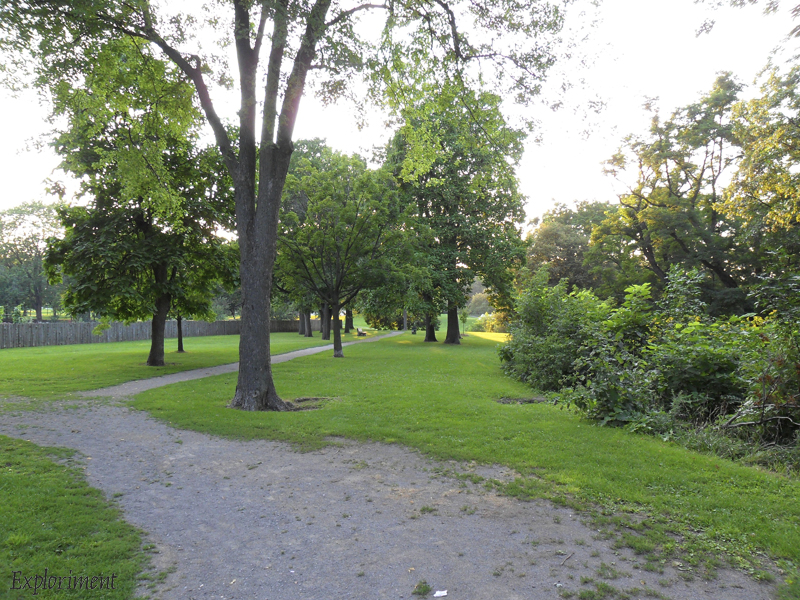
While I’m apparently the only kid in all of Ontario to have never gone on a school field trip here, it is now pretty much my backyard. The park that accompanies the Castle is quite sizable, fairly open yet dotted with big old trees, and always surprisingly quiet. Many a time I’ve been here with my nephew kicking a soccer ball around or throwing a frisbee or a boomerang around. I try to remind him often that he is really lucky to live in the area that we do and to be blessed with a big park so close to home. Not just the scenic and recreational potential of the area, but also the fact that it’s geologically and historically very interesting.

Subscribe to:
Posts (Atom)


 Posts
Posts


