Went to a meeting last night about the proposed Cootes to Escarpment Park. I’ve been aware of this for a while now, but the wheels seem to be turning and carrying it further forward with each revolution of the wheel. Hosted by the terrific Brian McHattie, our local city councillor, and presented by various representatives of the Royal Botanical Gardens, it was a very eye opening evening.
The two main speakers were Tys Theysmeyer, an Aquatic Ecologist and Head of Conservation for RBG, and Dr. David Galbraith, Head of Science for RBG.
Several representatives from some of the entities involved were there with literature and to answer questions. In addition to Councillor McHattie, Ted McMeekin, the Member of Provincial Parliament for the area, was also in attendance.
Several very forward thinking pioneers had the wherewithal to set aside land at the head of Lake Ontario decades ago. Realizing that Cootes Paradise wetland was a breeding area for the fish that populated Lake Ontario, it was the first area to be protected in 1927. In the early 1940’s, the Royal Botanical Gardens was established around it, and gradually they came to control large areas of land. All around it are areas that fall under the control or stewardship of a range of entities. The idea behind the CtEP is to unite all those various areas into one large park. Encompassing 1,500 hectares (3,700 acres) of natural areas, that are currently controlled by eight different agencies and organizations. (Bruce Trail Conservancy, City of Burlington, City of Hamilton, Conservation Halton, Hamilton Conservation Authority, Hamilton Harbour Remedial Action Plan, Hamilton Naturalists’ Club, Region of Halton, Royal Botanical Gardens). Fragmented by roads, railways and development, and spread over a wide area, uniting them into one park would make conservation and restoration a more manageable task. Some of the land surrounding it is currently owned by private entities, but efforts are being made through various channels to purchase those lands to make it less fragmented. This will form the largest protected urban area in the world, larger than Hyde Park in London, Bois de Boulogne in Paris or Central Park in New York. Uh...wow! It encompasses sizable portions of several watersheds, provides habitat for many rare wildlife species, and many endangered plant species. Nearly a quarter of Canada’s wild plant species can be found within its boundaries, and it is about the northernmost limit where Carolinian plants exist. It is one of the most biologically diverse and ecologically significant areas in Canada.
The idea that this area will be unified and expanded is really exciting. The chilling prospect that the population of the area surrounding it is projected to explode by a half million residents in the next twenty years, makes it imperative that we preserve ever more of our rapidly dwindling green spaces. You would need to go far from here to find anything of a comparable quality and quantity. The Rouge Valley north east of Toronto. Future generations will praise the foresight of those who held fast in the face of creeping urbanization. Like Thomas McQuesten many decades ago, new names and faces are emerging to bolster his efforts.
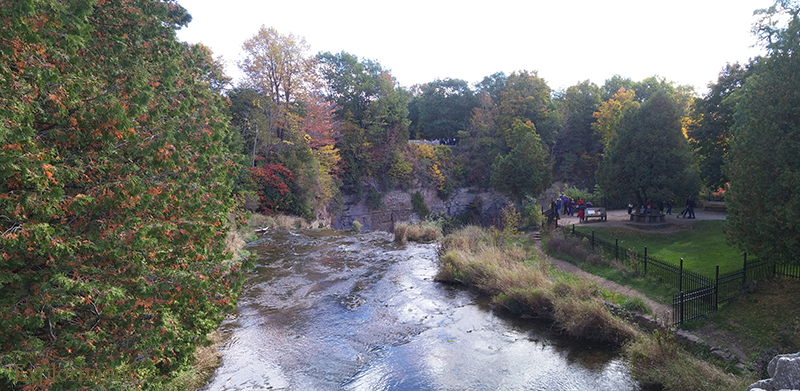
Hamilton often gets a drubbing as a dreary industrial/post-industrial town. But whenever people see the photos of the areas I hike in, they can’t believe it’s Hamilton. I love the fact that I can walk from my house and within a relatively short period of time I’m sitting among trees beside a body of water with wildlife around me. There is a growing body of evidence that life in crowded noisy cities isn’t good for our health, and time in nature helps to counteract those negative effects. With our planet becoming predominantly urban in makeup, being fortunate enough to live so close to a green gem like this will become ever more important. Kudos to the people who had the foresight to initiate this and I hope that I can contribute to this in some small way.




 Posts
Posts


