These are things my father made, and I think they’re so impressive I wanted to show them off.
I should explain that my dad was a watch maker, a tool and die maker, and an instrument (medical, not musical) maker. This explains why he had the skill and patience to do something this finicky and precise.
Among his many other interests he liked model trains. Sometime in the fifties, maybe sixties he made these in, I think it might be O scale, or maybe HO scale, clamshell bucket, also called a grab sometimes.
The larger variant.
I’m no expert, but I believe clamshell buckets are used more for things like loading and unloading ore and aggregate, and dredging, and I think in sandy soil as well. I don’t believe these are used so much for excavation of hard soil and the like.
This one works by means of a small pin and latch. It has to be tapped in order for it to open, ie. set the bucket down in the dump truck being loaded, the latch comes off the pin, it opens, the content spills out, it’s open for grabbing the next load, set it on the material to be picked up, the latch grabs the pin, it closes around the material, and can be hoisted for transferring.
I think on a real clamshell bucket, the operator can open and close the bucket from inside the crane. I don’t think the real ones need to be tapped in order for them to open. A limitation of the scale and the medium I suppose. But whatever, it works.


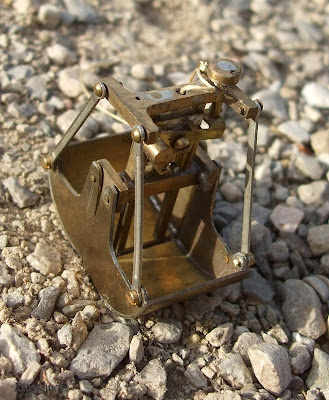

The first one he did was for I think O scale, or maybe HO scale, and then when it worked to his satisfaction he did one for HO scale, or maybe N scale.
He sawed and filed and drilled and machined all the parts from brass. In the smaller scale version, it’s a little over an inch wide and inch high.
After that he tackled an electro-magnetic one that could be opened and closed with the push of a button.
I’m under the impression that he designed these and sold the rights to a company, but he may have merely copied these to use for his own model train layout. It looks very similar to something a British company, Tri-ang sold. (Write-up about it. I gather it is very collectable and hard to find.) I really don’t know for sure what the facts are. Did he create this and sell it to Tri-ang, or merely copy it? He’s not around to ask any more.
To me it’s just a great example of what an ingenious mind and talented hands can come up with.


 Posts
Posts


