Showing posts with label fob. Show all posts

Sunday, 15 February 2015

Klever Kutter Karrier 2

I had one of the earlier models of this, and got a new model recently. Same basic idea, but it’s a bit bigger, so didn’t fit in the pouch I had made for the previous model.
Like the first one, I added a fob to help pull it out of the pouch / serve as a finger loop / identify it as mine.
Close up of the lanyard knot.
A co-worker liked what I had done and asked if I could put a neon green fob on. I only had about a foot of neon green paracord, that had already had the core taken out, which doesn’t really lend itself to doing the lanyard knot. So I put a spiral sinnet on instead.
The only webbing I had laying around that would fit was some 2.75" webbing. A bit wider than I wanted, but it was the quickest route to take. Not pretty, but it does the trick. (The previous version on the right.)
Being a bit wider, means I can also stick a pen in there.

Monday, 15 December 2014

Hitchcraft – Fenix E12 Ring Fob

My new Fenix E12 was mentioned as playing a helpful role in this happy story.

I’m sure arguments have raged for years on CandlePowerForums over which battery is the best, but I just gravitate towards lights that run on commonly available / rechargeable AA or AAA batteries. (18650 and CR123 batteries aren’t going to be found if I have to stop at a gas station along a highway in northern Ontario.) And I’m especially a fan of single AA lights. Maybe not the brightest, or the longest run time, for my needs they’re okay.

I have been a very happy user of a Fenix L1D for years, but wanted another, similar light.

I had been carrying this around in various pockets since getting it, intending to whip up a pouch for it. I also had grand schemes to take lots of photographs before I put this fobby, ringy thing on it. Like the pouch, neither idea was realized.

The fobby, ringy thing was realized this afternoon, and the pouch will be soon as well.
Details for all the flashaholics. 

Runs on one 1.5V AA battery, which powers a Cree XP-E2 LED with a 50,000 hour lifespan. Made of aircraft-grade aluminum with a Type III hard-anodized finish. It’s 90mm (3.54") long, with a 19mm (0.75") diameter, and a weight of 28.5gm (1.0 oz) without the battery. (1 AA cell can weigh between 15 g (0.81 oz) to 31 g (1.1 oz) ).Pressing the tail cap all the way down clicks the flashlight on or off. When it comes on it is at its lowest setting, 8 lumens, which will run for 40 hours on a Ni-MH and 22 hours with an alkaline battery. A tap on the tail cap, bumps it up to the mid level, 50 lumens which runs for 6½ hours on a Ni-MH and 3½ hours with an alkaline battery. Another tap bumps it up to its highest setting level, 130 lumens, which runs for 1½ hours on a Ni-MH and 1 hour with an alkaline battery. It’s digitally regulated, meaning that the the power drawn from the battery remains at a constant the whole time. No slowly waning light over a long time. Bright, even light for a given period, and then it dies. The maximum distance the light will reach out to is 88 meters (289'). It is rated to survive a drop from 1 meter (3.3'), and has an IPX-8 rating to be waterproof to a depth of 2 meters for 30 minutes.

Unlike the L1D I have, only one side of the light opens up, the bottom (light end).There is no tail cap switch out, but the, end you open to get at the battery takes care of that by rotating it slightly. No strobe or SOS function, but lightly tapping the tail switch, makes for a rudimentary strobe.

Goes for around the $30 mark.
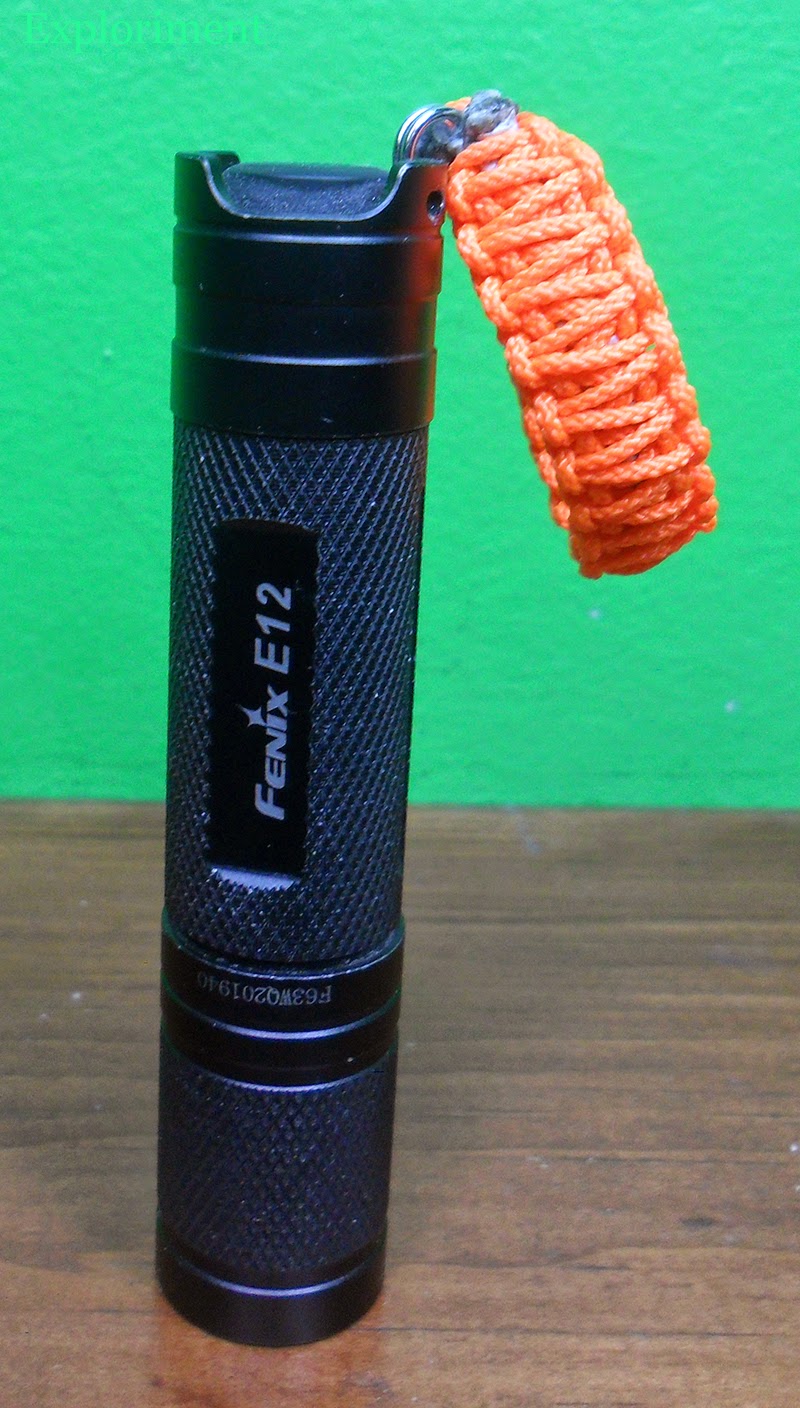
The ring fob serves as a tactile indicator, both what it is and which end it is, to pull it from a pouch or pocket, and as a more secure way to hold it. I can grasp it to shine on something, but I can also drop it, still retain it, and do whatever I need to do with my fingers.
 8 lumens.
130 lumens.
It can be hooked over either the forefinger or thumb, although I prefer the forefinger.
Here you can see a flaw where the grey Spectra cord I used as a base shows through. Two loops worth that I sewed together side by side, since I didn’t want to have a bump from a knot in it. Covered that with neon orange micro-cord in a solomon bar or cobra knot.
Some views of several indented rings, beveled areas on the tube and areas of knurling that make it a very grippable light.

If there is a drawback to this addition, it’s that I can’t stand it up on the tail now. Not that was ever really a consideration, so the drawback is a very minor one.

If you look really closely you can see where some of the anodizing has been damaged by several weeks/months of being carried around in pockets with keys, lighters, etc. Putting the split ring on the back also marred it a little bit. I don’t mind, expect it, and if I wanted a pristine light I would leave it in the packaging in a safe. I get lights to use them and expect them to get dinged up.

So far this has been another terrific little light from Fenix. Light, as in the weight sense. Bright. Several very useful modes. Nothing it doesn’t need. Fits easily in a pocket or pouch. Good self defence item. Runs on a battery type that is utterly ubiquitous, and can be had in rechargeables. $30. Added a ring fob to it which makes it even better. Also shows off my Netherlandic pride and makes it easy to find if I drop it.

Monday, 23 June 2014

Klever Kutter Karrier

A place I work at sometimes insists people use these “Klever Kutters” to open boxes. I thought it was silly, but whatever. 
It works I guess, although I did see people get injured by them. They flail away at pallet wrap with it, hit the pallet, the tip breaks off, they don’t notice and when they reach into their pocket to grab it, they slice a finger open. I’m of the mind set that how you use a tool is more an indicator of whether you’ll get injured by it rather than thinking that a safety feature will protect without fail. I’d rather someone with a clue uses whatever cutting tool they can manage safely, than think an 18 year knucklehead won’t manage to foolishly misuse a “fool-proof” gimmick. 

It worked all right for the number of times I used it, but the Spyderco Tenacious I carry could have done the job just as well and just as safely - because I use it safely.

I decided to make a little sheath for it.
Just used some seat belt webbing I had laying around. Folded it in 3 - one part forms the belt loop, one part forms the holder.
I put some seam tape at the ends. Sewn by hand on breaks one day.
Realized a limitation the first time I used it - with a belt loop that goes all the way to the bottom, pulling on the tool, pulls the sheath all the way up, and made it tough to get the tool back in.
Nothing a couple of stitches didn’t remedy.
And of course, I also added a lanyard, with two lanyard knots. I can pull it out of the sheath easier, and the loop is big enough to put two fingers through, meaning I could hang on to it while I used my fingers for other tasks.
Simple carrier for a little tool that works, but that I would never have spent my own money on by choice.

Sunday, 29 December 2013

Hitchcraft – Kifaru Pullout Lanyard Knots

Now that I’ve figured out that the lanyard knot isn’t actually that hard to tie, I’ve been looking for excuses to put them in various spots. Going through stuff, I saw that I never switched out the loop of paracord tied in an overhand knot on the Kifaru Pullouts I have.

I have a small Pullout in 525D in all the colours they offer. The foliage green one got a UCP zipper pull, the coyote brown one got a desert camo zipper pull, and the olive drab one got a woodland camo zipper pull.

I’ve been liking thinner cord lately, but for doing the lanyard knot, the chunkier 550 cord is preferable to work with.

Monday, 2 December 2013

Hitchcraft – Leatherman WAVE

I mentioned in a recent post, finding some Atwood Microcord. Having also recently figured out the Lanyard knot, I wanted to do it a bunch more times to get better at it. So, I put a new sinnet on my Leatherman WAVE. Well, one of them anyway. I put a clip on it so that I can remove when needed. It’s handy for yanking out of a deep pouch, but if you have to do much screwdrivering, it’s a nuisance.

Sunday, 17 November 2013

Hitchcraft – Microcord

When I first got into making sinnets and the like, I used 550 paracord. It’s what I had. But it is kind of bulky. The resulting fobs, zipper pulls and the like ended up a burly item. Which can be fine in certain instances, but I started playing around with thinner cord, and liked the results better. One in particular was Type 1 cord, but when I ordered it, the colour choices were very limited, and I only got OD and foliage green. I intended to order some more colour (now that the palette has increased) when next I put in an order.

While browsing around at the generally craptastic surplus store near me, I stumbled across a bunch of cord in different colours.

Atwood Micro Cord. Thinner than the type 1. For the price, what the heck, try out a few.
A not so great photo showing the difference in size between 550 cord, type 1 cord and micro cord.
I grabbed spools of black (which I think may actually be a very dark navy blue), dark grey, orange, purple and red.

One odd thing is that the purple and grey are fairly stiff, where as the other three are quite a bit more flexible.
A red and grey fob for my Victorinox Huntsman.
Purple zipper pulls on a purple fleece jacket. Nice and grippy.
Zipper pull on a pouch that holds all my cables.
Purple solomon bar over a light grey Spectra line core. With two lanyard knots at either end - the first time I’ve managed that one. The tutorials I had tried weren’t that clear, but finally found one that I could understand. That and a bit of perseverance.

That’s what I’ve done so far with this cord. I’m sure more will follow.